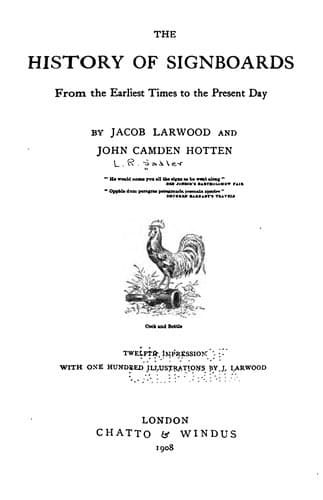
The History of Signboards, from the Earliest times to the Present DayHotten, John Camden
History
The History of Signboards, from the Earliest times to the Present Day
Hotten, John Camden
Inn signs -- England -- History; Signs and signboards -- History
All the combinations of the sign of the Dog point towards sports, as the
DOG AND BEAR, which was very common in the seventeenth century, when
bear-baiting was in fashion, and kings and queens countenanced it by
their presence. The DOG AND DUCK refers to another barbarous pastime,
when ducks were hunted in a pond by spaniels. The pleasure consisted in
seeing the duck make her escape from the dog’s mouth by diving. It was
much practised in the neighbourhood of London till the beginning of this
century, when it went out of fashion, as most of the ponds were
gradually built over. One of the most notorious DOG AND DUCK Taverns
stood in St George’s Fields, where Bethlem Hospital now stands; it had a
long room with tables and benches, and an organ[276] at the upper end.
In its last days it was frequented only by thieves, prostitutes, and
other low characters. After a long and wicked existence it was at length
put down by the magistrates. In the seventeenth century it was famous
for springs, but already in Garrick’s time its reputation was very
equivocal:
“St George’s Fields, with taste and fashion struck,
Display Arcadia at the _Dog and Duck_,
And Drury Misses, here in tawdry pride,
Are there “Pastoras” by the fountain side;
To frowsy bowers they reel through midnight damps,
With Fauns half drunk and Dryads breaking lamps.”[277]
In an unpublished paper from the MS. collection of William Hone, we have
a mention of it:--
“It was a very small public-house till Hedger’s mother took it, who
had been a barmaid to a tavern-keeper in London, who left this house
to her at his death. Her son Hedger then was a postboy to a yard I
believe at Epsom, and came to be master there. After making a good
deal of money he left the house to his nephew, one Miles, (though it
still went in Hedger’s name,) who was to allow him £1000 per annum out
of the profits, and it was he that allowed the house to acquire so
bad a character that the licence was taken away. I have this from one
William Nelson who was servant to old Mrs Hedger, and remembers the
house before he had it. He is now [1826] in the employ of the Lamb
Street Water Works Company, and has been for thirty years. In
particular, there never was any duck hunting since he knew the
Gardens. Therefore, if ever, it must have been in a very early time
indeed. Hedger, I am told, was the first person who sold the mineral
water, (whence the St George’s Spa.) In 1787, when Hedger applied for
a renewal of his licence, the magistrates of Surrey refused, and the
Lord Mayor came into Southwark and held a court and granted the
licence, in despite of the magistrates, which occasioned a great
disturbance and litigation in the law courts.”
The old stone sign is still preserved, embedded in the brick wall of the
garden of Bethlehem Hospital, visible from the road, and representing a
dog squatted on his haunches, with a duck in his mouth, and the date
1617.
Public-domain text, read in full here on John Shaqi.
Reviews
Reviews
No reviews yet
Be the first to share your thoughts on this work.
Elsewhere in the archive
Join the Discussion
Join the discussion
Sign in to leave a comment or review.
Sign InorCreate an account