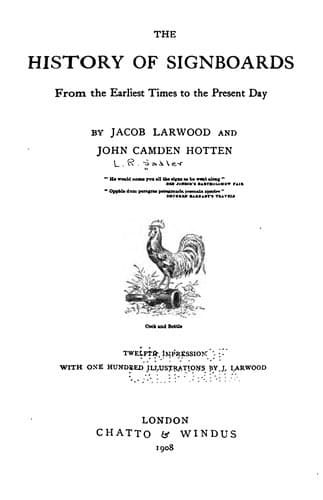
The History of Signboards, from the Earliest times to the Present DayHotten, John Camden
History
The History of Signboards, from the Earliest times to the Present Day
Hotten, John Camden
Inn signs -- England -- History; Signs and signboards -- History
Another famous Dog and Duck inn formerly stood on the site of Hertford
Street, in the now aristocratic precincts of May Fair. It was an
old-fashioned wooden public-house, extensively patronised by the
butchers and other rough characters during May Fair time. The pond in
which the cruel sport took place was situated behind the house, and for
the benefit of the spectators was boarded round to the height of the
knee, to preserve the over-excited spectators from involuntary
immersions. The pond was surrounded by a gravel walk shaded with willow
trees.
THE DOG AND BADGER, Kingswood, Gloucester, refers to the now obsolete
sport of badger-baiting. More genial sports, however, are called to mind
by the DOG AND GUN, DOG AND PARTRIDGE, DOG AND PHEASANT, all of which
are very common.
“As I was going through a street of London, where I never had been till
then, I felt a general clamp and faintness all over me, which I could
not tell how to account for, till I chanced to cast my eyes upwards and
found that I was passing under a signpost on which the picture of a
_cat_ was hung.” This little incident of the cat-hater, told in No. 538
of the _Spectator_, is a proof of the presence of cats on the signboard,
where, indeed, they are still to be met with, but very rarely. There is
a sign of the CAT at Egremont, in Cumberland, a BLACK CAT at St
Leonard’s Gate, Lancaster, and a RED CAT at Birkenhead. There is also a
sign of the Red Cat in the Hague, Holland, and “thereby hangs a tale.”
It was put up by a certain Bertrand, a Frenchman, who had left his
native country, having been mixed up in some conspiracy against Mazarin.
Arrived at the Hague, he opened a cutler’s shop, and put up a double
sign, representing on the one side a red cat, on the other a portrait of
his Eminence Cardinal Mazarin in his red gown, and with his bristling
moustache; underneath he wrote “_aux deux méchantes bêtes_” (the two
obnoxious animals.) Holland, however, was at peace with France at that
time, and so the Burgomaster, afraid of offending the French ambassador,
requested Bertrand to alter his sign. Mazarin’s face was then painted
out and another red cat put in its place. Gradually as the first sign
was forgotten, the name became unmeaning, and was finally altered into
the Red Cat, and in this shape it has come down to the present day,
still the sign of a cutler, and a descendant of Bertrand.[278]
The CAT AND LION, which we meet with sometimes, as at Stockport, was
probably at one time the Tiger and Lion. It is occasionally accompanied
by the following elegant distich:--
“The lion is strong, the cat is vicious,
My ale is strong, and so is my liquors.”
Public-domain text, read in full here on John Shaqi.
Reviews
Reviews
No reviews yet
Be the first to share your thoughts on this work.
Elsewhere in the archive
Join the Discussion
Join the discussion
Sign in to leave a comment or review.
Sign InorCreate an account