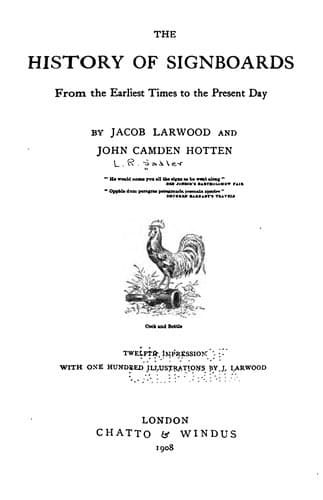
The History of Signboards, from the Earliest times to the Present DayHotten, John Camden
History
The History of Signboards, from the Earliest times to the Present Day
Hotten, John Camden
Inn signs -- England -- History; Signs and signboards -- History
With regard to the SWAN AND SUGARLOAF, which occurs amongst the trades
tokens, and is still seen, (as in Fetter Lane, for instance,) the
sugarloaf was at first added by a grocer, whose sign having gained
popularity as a noted landmark, or from other causes, was imitated by
rivals or juniors, particularly on account of its presenting the
favourite alliteration. Combinations with the sugarloaf are very common,
all arising from its being the grocer’s sign: thus the THREE CROWNS AND
SUGARLOAF, Kidderminster; WHEATSHEAF AND SUGARLOAF, Ratcliff Highway,
seventeenth century, (trades token;) TOBACCO ROLL AND SUGARLOAF, Gray’s
Inn Gate, Holborn;[302] the THREE COFFINS AND SUGARLOAF, Fleet Street,
1720.
In the sign of the SWAN AND RUSHES, at Leicester, the rushes were merely
a pictorial accessory, placed in the background to bring out the white
plumage of the Swan, whilst the SWAN AND HELMET, at Northampton, no
doubt originated from a helmet with a Swan for crest.
In one instance, a DRAKE occurs as a sign, namely, on the token of Will.
Johnson, at “ye Drake in Bell Yard,” near Temple Bar, 1667. The Duck is
only to be seen in company with the Dog; in one instance it accompanies
a Mallard. This last animal was otherwise well known to the Londoners,
since in 1520, amongst “the articles of good gouernãce of the cite of
London,” it was recommended to magistrates--“also ye shall enquyre, yf
ony person kepe or norrysh hoggis, oxen, kyen, or _mallardis_ within the
ward in noying of ther neyhbours.”[303] The DUCK AND MALLARD was the
sign of a lock (and probably gun-) smith in East Smithfield in
1673.[304]
The PIGEON was a tavern at Charing Cross in 1675.[305] The THREE PIGEONS
were very common; there still exists an inn of this name at Brentford:--
“It is a house of interest as being in all likelihood one of the few
haunts of Shakespeare now remaining; as being indeed the sole
Elizabethan tavern existing in England, which in the absence of direct
evidence, may fairly be presumed to have been occasionally visited by
him.”[306]
It was kept at one time by Lowin, one of the original actors in
Shakespeare’s plays, and is often named by the old dramatists:
“Thou art admirably suited for the _Three Pigeons_ at Brentford. I
swear I know thee not.”--_The Roaring Girl._
“We will turn our courage to Braynford, westward,
My Bird of the Night--to the Pigeons.”
_Ben Jonson’s Alchymist._
There, also, George Peel played some of his merry pranks. In the parlour
is an old painting dated 1704, representing a landlord attending to some
customers seated at a table in the open air, with these lines:--
“Wee are new beginners
And thrive wee would fain,
I am honest Ralph of Reading,
My wife Susana to name.”
Public-domain text, read in full here on John Shaqi.
Reviews
Reviews
No reviews yet
Be the first to share your thoughts on this work.
Elsewhere in the archive
Join the Discussion
Join the discussion
Sign in to leave a comment or review.
Sign InorCreate an account