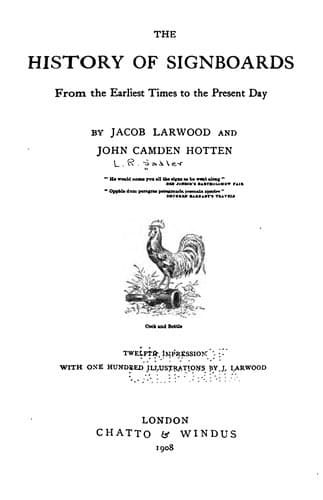
The History of Signboards, from the Earliest times to the Present DayHotten, John Camden
History
The History of Signboards, from the Earliest times to the Present Day
Hotten, John Camden
Inn signs -- England -- History; Signs and signboards -- History
Bat Pidgeon, the famous hairdresser, immortalised by the _Spectator_,
lived at the sign of the Three Pigeons, “in the corner house of St
Clement’s Churchyard, next to the Strand.” There he remained as late as
1740, when he cut the “boyish locks” of Pennant.
In 1663 it was the sign of a bookseller in St Paul’s Churchyard,[307]
and in 1698 of John Newton, also a bookseller over against Inner Temple
Gate, Fleet Street.
The DOVE was the sign of a coffeehouse on the riverside, between the two
malls at Fulham. “In a room in this house, Thomson wrote part of his
‘Winter.’ He was in the habit of frequenting the house during the winter
season, when the Thames was frozen and the surrounding country covered
with snow. This fact is well authenticated, and many persons visit the
house to the present day.”[308] The STOCKDOVE is a sign at Romiley,
Stockport; the DOVECOTE is a public-house at Laxton, Carlton-on-Trent,
probably on account of the _pigeons_ constantly flying out and in; and
there is a PIGEON BOX at Prior’s Lee, near Shiffnall. The
pigeon-shooting matches may have something to do with the selection of
this sign.
The FALCON was another of the devices used by Wynkyn de Worde over his
shop in Fleet Street. Falcon Court, in that locality, perhaps derives
its name from this house. Subsequently, Gordobuc, the earliest English
tragedy, was “imprynted at London, in Flete Strete, at the sign of the
Faucon,” no doubt Wynkyn’s house, by William Griffiths in 1565; and in
1612, Peacham’s “Garden of Heroical Devises” was published by Wa. Dight
at the sign of the Falcon in Shoe Lane. These booksellers, perhaps,
borrowed their device from the stationers’ arms, which are, argent on a
chevron between three bibles, or, a _falcon_ volant between two roses,
the Holy Ghost in chief; it was also a badge of some of the kings. At
the Falcon inn, Stratford-on-Avon, there is still a shovelboard on which
William Shakespeare is said often to have played. Another Falcon Tavern
connected with Shakespeare’s name used to stand on the Bankside, where
he and his companions occasionally refreshed themselves after the
fatigues of the performances at the Globe. It long continued celebrated
as a coaching inn for all parts of Kent, Surrey, and Sussex, till it was
taken down in 1808. The name is still preserved in the Falcon
Glass-house, which stands opposite its site, and in the Falcon Stairs.
There was another Falcon Inn in Fleet Street, bequeathed to the company
of cordwainers, by a gentleman named Fisher, under the obligation that
they were yearly to have a sermon preached in the Church of St Dunstan,
in the West, on the 10th of July. Formerly, on that day, sack and posset
used to be drunk by those concerned, in the vestry of the church, if not
to the health, at least to the “pious memory” of this Fisher; but that
good custom has long since been abandoned.
Public-domain text, read in full here on John Shaqi.
Reviews
Reviews
No reviews yet
Be the first to share your thoughts on this work.
Elsewhere in the archive
Join the Discussion
Join the discussion
Sign in to leave a comment or review.
Sign InorCreate an account