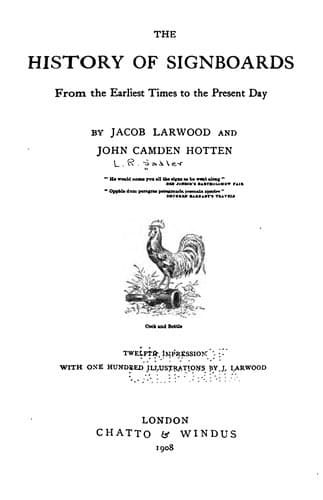
The History of Signboards, from the Earliest times to the Present DayHotten, John Camden
History
The History of Signboards, from the Earliest times to the Present Day
Hotten, John Camden
Inn signs -- England -- History; Signs and signboards -- History
The oldest sign borrowed from the vegetable kingdom is the Bush; it was
a bush or bunch of ivy, box or evergreen, tied to the end of a pole,
such as is represented in many of the suttler’s tents in the pictures of
Wouverman. The custom came evidently from the Romans, and with it the
oft-repeated proverb, “Good wine needs no Bush.” (_Vinum vendibile
hedera non est opus_; in Italian, _Al buon vino non bisogna frasca_; in
French, _à bon vin point d’enseigne_.) Ivy was the plant commonly used:
“The Tavern Ivy clings about my money and kills it,” says the sottish
slave in Massinger’s “Virgin Martyr,” (a. iii. s. 3.) It may have been
adopted as the plant sacred to Bacchus and the Bacchantes, or perhaps
simply because it is a hardy plant, and long continues green. As late as
the reign of King James I. many inns used it as their only sign. Taylor,
the water poet, in his perambulation of ten shires around London, notes
various places where there is “a taverne with a bush only;” in other
parts he mentions “the signe of the Bush.” Even at the present day “the
Bush” is a very general sign for inn and public-house, whilst sometimes
it assumes the name of the IVY BUSH, or the IVY GREEN, (two in
Birmingham.) In Gloucester, Warwick, and other counties, where at
certain fairs the ordinary booth people and tradesmen enjoy the
privilege of selling liquors without a licence, they hang out bunches of
ivy, flowers, or boughs of trees, to indicate this sale. As far away as
the western States of North America, at the building of a new village,
or station, it is no uncommon thing to see a bunch of hay, or a green
bough, hung from above the “grocery,” or bar-room door, until such time
as a superior decoration can be provided. The bunch being fixed to a
long staff was also called the Alepole; thus among the processions of
odd characters that came to purchase ale at the Tunnyng of Elinour
Rummyng:--
“Another brought her bedes
Of jet or of coale,
To offer to the _Alepole_.”
How these Alepoles, from the very earliest times, continued to enlarge
and encroach upon the public way, has been shown in our Introduction,
pp. 16, 17. The Bunch gradually became a garland of flowers of
considerable proportions, whence Chaucer, describing the Sompnour,
says:--
“A garlond hadde he sette upon his hede
As gret as it were for an alestake.”
Afterwards it became a still more elegant object, as exemplified by the
Nagshead in Cheapside, in the print of the entry of Marie de Medici;
finally it appeared as a crown of green leaves, with a little Bacchus,
bestriding a tun dangling from it. Thus the sign was used simultaneously
with the bush.
“If these houses [ale-houses] have a boxe-bush, or an old post, it is
enough to show their profession. But if they be graced with a signe
compleat, it’s a signe of a good custome.”[326]
Public-domain text, read in full here on John Shaqi.
Reviews
Reviews
No reviews yet
Be the first to share your thoughts on this work.
Elsewhere in the archive
Join the Discussion
Join the discussion
Sign in to leave a comment or review.
Sign InorCreate an account