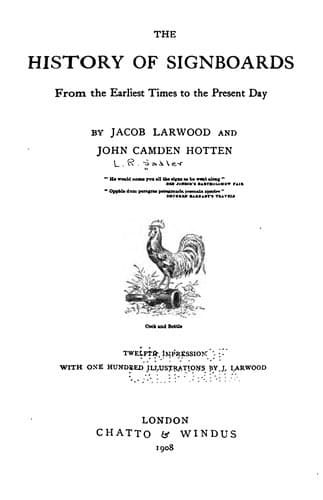
The History of Signboards, from the Earliest times to the Present DayHotten, John Camden
History
The History of Signboards, from the Earliest times to the Present Day
Hotten, John Camden
Inn signs -- England -- History; Signs and signboards -- History
In a mask of 1633, the constituents of a tavern are thus described:--“A
flaminge red lattice, seueral drinking roomes, and a backe doore, but
_especially a conceited signe and an eminent bush_.” “Tavernes are
quickly set up, it is but hanging out a bush at a nobleman’s or an
alderman’s gate, and ’tis made instantly.”--_Shirley’s Masque of the
Triumph of Peace._ In a woodcut from the “Cent Nouvelle Nouvelles,”
introduced in Wright’s “Domestic Manners,” the Bush is suspended from a
square board, on which the sign was painted; for in France as well as in
England, signboard and bush went together:--
“La taverne levée
_L’enseigne et le bouchon_,
La dame bien peignée
Les cheveux en bouchon.”[327]
--_Chanson nouvelle des Tavernes et Tavernières, Fleur des Chansons
Nouvelles, Lyon_, 1586.
Whilst an English host in “Good News and Bad News,” says:--“I rather
will take down my bush and sign than live by means of riotous expense.”
Gradually, as signs became more costly, the bunch was entirely neglected
and the sign alone remained.
The HAND AND FLOWER is a sign very frequently adopted by alehouses in
the vicinity of nursery grounds:--thus, there is one in the High Street,
Kensington, and one in the King’s Road, a little past Cremorne, though
there the nursery ground has very recently been built over.
The ROSE, besides being the queen of flowers, and the national emblem,
had yet another prestige which alone would have been sufficient to make
it a favourite sign in the middle ages; this was its religious import.
On the monumental brass of Abbot Kirton, formerly in Westminster Abbey,
there was a crowned rose with I.H.C. in its heart, and round it the
words
SIS, ROSA, FLOS FLORUM, MORBIS MEDECINA MEORUM.[328]
And in Caxton’s Psalter, above a woodcut representing an angel holding a
shield with a rose on it, occur the words:--
“Per te rosa toluntur vitia,
Per te datur mestis leticia.”[329]
It was evidently an emblem of the Virgin, and may contain some allusion
to the Rose of Jericho, or to the Christmas rose.
Public-domain text, read in full here on John Shaqi.
Reviews
Reviews
No reviews yet
Be the first to share your thoughts on this work.
Elsewhere in the archive
Join the Discussion
Join the discussion
Sign in to leave a comment or review.
Sign InorCreate an account