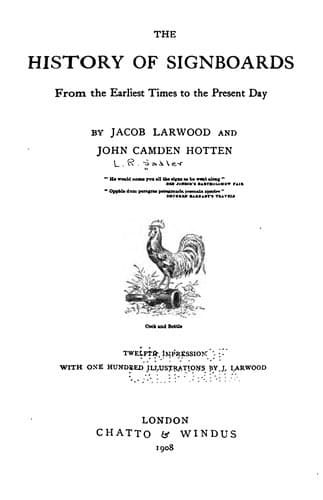
The History of Signboards, from the Earliest times to the Present DayHotten, John Camden
History
The History of Signboards, from the Earliest times to the Present Day
Hotten, John Camden
Inn signs -- England -- History; Signs and signboards -- History
The colloquial phrase, UNDER THE ROSE, is sometimes used as a sign, or
written under the pictorial representation of the rose; it occurs on a
trade’s token of Cambridge,[331] and may be seen on various
public-houses of the present day. Numerous suppositions have been made
concerning its origin, some holding that it arose from this flower being
the emblem of Harpocrates; others from a rose painted on the ceiling,
any conversations held under which were not to be divulged; whilst
Gregory Nazianzen seems to imply that the rose, from its close bud, had
been made the emblem of silence.
“Utque latet rosa verna suo putamine clausa,
Sic os vincla ferat, validis arcietur habenis,
Indicatque suis prolixa silentia labris.”[332]
At Lullingstone Castle, in Kent, the residence of Sir Percival Dyke,
Bart., there is, says a correspondent of Notes and Queries, a
representation of a rose nearly two feet in diameter, surrounded with
the following inscription:--
“Kentish true blue
Take this as a token,
That what is said here
Under the Rose is spoken.”
The Dutch have a similar phrase. In an old Book of Inscriptions of the
seventeenth century is a device written round a rose painted on the
ceiling:--
“Al wat hier onder de Roos geschied,
Laat dat aldaar en meld het niet.”[333]
There is one sign of the Rose, the origin of which it is difficult to
ascertain, this is the ROSE OF NORMANDY, a public-house in the High
Street, Marylebone. It was built in the seventeenth century, and is the
oldest house in that parish. In 1659 it is described as having
“Outside a square brick wall set with fruit trees, gravel walks 204
paces long, 7 broad; the circular wall 485 paces long, 6 broad; the
centre square, a bowling-green, 112 paces one way, 88 another--all,
except the first, double set with quickset hedges, full grown, and
kept in excellent order, and indented like town walls.”[334]
The street having been raised, the entrance to the house is at present
some steps beneath the roadway. The original form of the exterior has
been preserved, and the staircases and balusters are coeval with the
building; but the garden and large bowling-green have dwindled into a
miserable skittle-ground.
As a sign the MARYGOLD, it is said, arose from a popular reading of the
sign of the SUN; a very natural and plausible origin. At the same time,
it is just worth mentioning, that this flower (originally called _the
Gold_) seems to have been considered as an emblem of Queen Mary; so, at
least, it would appear from a lengthy ballad of “the Marygolde,”
composed by her chaplain, William Forrest, in which, amongst many other
similar allusions, the following words are found:--
Public-domain text, read in full here on John Shaqi.
Reviews
Reviews
No reviews yet
Be the first to share your thoughts on this work.
Elsewhere in the archive
Join the Discussion
Join the discussion
Sign in to leave a comment or review.
Sign InorCreate an account