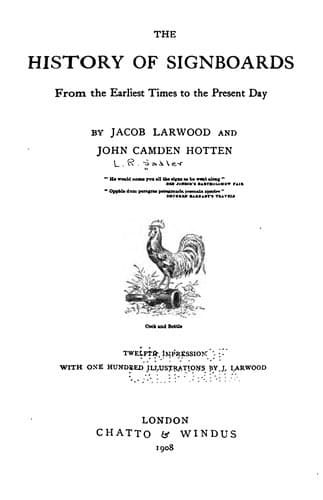
The History of Signboards, from the Earliest times to the Present DayHotten, John Camden
History
The History of Signboards, from the Earliest times to the Present Day
Hotten, John Camden
Inn signs -- England -- History; Signs and signboards -- History
“She [the Queen] may be called Marygolde well,
Of _Marie_ (chiefe) Christes mother deere,
That as in heaven she doth excell,
And _golde_ on earth to have no peere,
So certainly she shineth cleere,
In grace and honour double fold,
The like was never erst seen heere,
Such as this flower the Marygolde.”
The flower was a favourite one in the middle ages, deriving the first
part of its name from the Virgin Mary. No mention of the actual use of
the sign, however, has been met with previous to 1638, when it appears
on the title-pages of Francis Eglisfield, a bookseller in St Paul’s
Churchyard. His name still occurs at the same house in 1673,[335] when
it was also the sign of “Mr Cox, milliner, over against St Clement’s
Church in the Strand.”[336] This must have been the same house in which
Richard Blanchard and Francis Child, the goldsmiths, kept their “running
cashes.”[337] It is the oldest banking firm in London. Francis Child,
the founder, was, in the reign of Charles I., apprenticed to a
goldsmith, William Wheeler, whose shop stood on the same spot now
occupied by the bank. He married his master’s daughter, and thus laid
the foundation of his immense fortune. Many bills and other papers
relating to Nell Gwynn are still preserved by this firm, as well as
various documents concerning the sale of Dunkerque. Alderman Blackwell,
who was ruined by the shutting up of the Exchequer in the reign of
Charles II., was at one time a partner in this house. It was here that
Dryden deposited the £50 offered for the discovery of the bullies of the
“Rose-alley cudgel ambuscade.”[338] The old sign of the house is still
preserved by their successors, together with various relics of the Devil
Tavern, on the site of which it was built.
Only a few other flowers occur, mostly modern introductions. The DAISEY,
Bramley, Leeds; the TULIP, Springfield, Chelmsford; the LILIES OF THE
VALLEY, Ible, near Wirksworth; the SNOWDROP, near Lewes; WOODBINE
Tavern, South Shields; and the FOREST BLUE BELL, Mansfield. The Blue
Bell is very common, but, _inter doctores lis est_, whether it signifies
the little blue flower, or a bell painted blue.
As a sequel to the flowers, we may name the MYRTLE tree, of which there
are two in Bristol, and the ROSEMARY BRANCH, in Camberwell, and in many
other places. Rosemary was formerly an emblem of Remembrance, in the
same way as the Forget-me-not is now; “There’s Rosemary, that’s for
_remembrance_,” says Ophelia, (Hamlet, ac. iv., s. 5,) and in Winter’s
Tale, Perdita says:--
“For you, there’s Rosemary and Rue, these keep
Seeming and savour all the winter long,
Grace and _remembrance_ be to you both.”
_Winter’s Tale_, ac. iv., s. 4.
Hence Rosemary and gloves were of old presented to those who followed
the funeral of a friend.
Public-domain text, read in full here on John Shaqi.
Reviews
Reviews
No reviews yet
Be the first to share your thoughts on this work.
Elsewhere in the archive
Join the Discussion
Join the discussion
Sign in to leave a comment or review.
Sign InorCreate an account