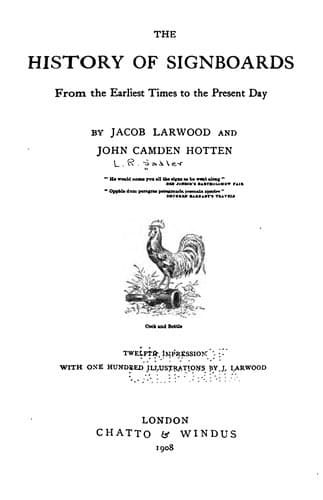
The History of Signboards, from the Earliest times to the Present DayHotten, John Camden
History
The History of Signboards, from the Earliest times to the Present Day
Hotten, John Camden
Inn signs -- England -- History; Signs and signboards -- History
Orange trees were one of the ornaments of St James’ Park in the reign of
Charles II.; and at that period and long after, were mostly used as
signboards of the seed-shops, and by Italian merchants. The ORANGE-TREE
AND TWO JARS was the sign of a shop of the latter description in the
Haymarket in 1753.[343] No doubt, the orange tree must have obtained
some popularity in the reign of William III., as it is the emblem of the
Orange family. The orange tree is said to be originally a Chinese plant,
(whence they were formerly called China oranges.) They were unknown to
the ancients, and introduced by the Moors into Sicily in the twelfth
century. France possessed them in the fourteenth century; and probably
much about the same period they were brought to England, for we find
“pome d’orring” mentioned as one of the items at the coronation dinner
of Henry IV. in 1399, where they occur in the third course, along with
_quincys en comfyte doucettys_, and other items of a modern
dessert.[344] But a still earlier instance is mentioned in the “Book of
Days,” (vol. ii. p. 694,) viz., in 1290, when a large ship from Spain
arrived at Portsmouth laden with spices. On this occasion, Queen Eleanor
of Castile, anxious to taste again the luscious fruit that reminded her
of her home in sunny Spain and the days of her girlhood, bought out of
the cargo “a frail of figs, of raisins, and of grapes, a bale of dates,
230 pomegranates, 15 citrons, and 7 oranges.” This probably is the
oldest mention of the orange being brought to England. The tree is said
to have been introduced into this country by a member of the Carew
family. Oranges are named amongst the articles of diet consumed by the
Lords of the Star Chamber in 1509, when their price is quoted one day at
iijd., and another at ijd., whilst the charge for strawberries was
vijd., and on another day iiijd.[345] Perhaps, however, they were only
used as _hors d’œuvres_, for Randle Holme, in his instructions how to
arrange a dinner, (in that _omnium gatherum_, “Academy of Armory,”)
mentions oranges and lemons as the first item of the second course. At
all events, they were abundant enough in 1559, for on May day of that
year the revellers “at the queen’s plasse at Westmynster shott and threw
eges and _orengs_ on a-gaynst a-nodur.”[346] In an “Account of several
Gardens near London,” in 1691,[347] Beddington Gardens are
mentioned--then in the hands of the Duke of Norfolk, but belonging to
the Carew family--as having in it the best oranges in England. The
orange and lemon trees grew in the ground, “and had done so near one
hundred years, the house in which they were being above 200 feet long.
Each of the trees was about 13 feet high, and generally full of fruit,
producing above 10,000 oranges a year.” Sir William Temple’s oranges at
Sheen are also praised. It is, indeed, a pity that this plant has so
much gone out of fashion; for, besides being always green, it bears
Public-domain text, read in full here on John Shaqi.
Reviews
Reviews
No reviews yet
Be the first to share your thoughts on this work.
Elsewhere in the archive
Join the Discussion
Join the discussion
Sign in to leave a comment or review.
Sign InorCreate an account