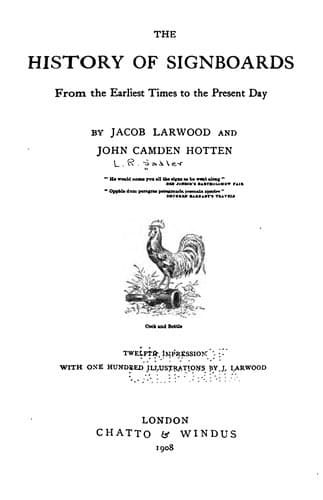
The History of Signboards, from the Earliest times to the Present DayHotten, John Camden
History
The History of Signboards, from the Earliest times to the Present Day
Hotten, John Camden
Inn signs -- England -- History; Signs and signboards -- History
The CABBAGE is an ale-house sign at Hunslet, Leeds, and at Liverpool,
and CABBAGE HALL, opposite Chaney Lane, on the road to the Lunatic
Asylum, Oxford, was formerly the name of a public-house kept by a
tailor; but whether he himself had christened it thus, or his customers
had a sly suspicion that it owed its origin to _cabbaging_, history has
omitted to record. Another public-house, higher up the hill, was known
by the name of CATERPILLAR HALL, a name clearly selected in compliment
to Cabbage Hall, intimating that it meant to draw away the customers
from Cabbage Hall, in other words, that the caterpillar would eat the
cabbage. The OXNOBLE, a kind of potato, is the name of a public-house in
Manchester, and the homely mess of PEASE AND BEANS was a sign in Norwich
in 1750.[363] The THREE RADISHES was, in the seventeenth century, a
common nursery and market gardener’s sign in Holland. There was one near
Haarlem, to which was added a representation of Christ appearing to Mary
Magdalene in the garden, with this rhyme--
“Christus vertoont men hier
Na zyn dood in verryzen,
Als een groot hovenier
Die ieder een moet pryzen.
Dit ’s in de drie Radyzen.”[364]
Another, near Gouda, had a still more absurd inscription:--
“Adam en Eva leefden in den Paradyze
Zelden aten zy stokvisch maar veel warmoes, kropsla en radyzen.
Hier vindt gy allerley aardgewas om menschen mêe te spyzen.”[365]
The WHEATSHEAF is an extremely common inn, public-house, and baker’s
sign; it is a charge in the arms of these three corporations, besides
that of the brewers. In the middle of Farringdon Street, opposite the
vegetable market, is Wheatsheaf Yard, once a famous waggon inn, which
also did a roaring trade in wine, spirits, and Fleet Street marriages.
Indeed, most of the large inns within the liberties of the Fleet served
as “marriage shops” between 1734 and 1749; amongst the most famous were
the BULL AND GARTER, the HOOP AND BUNCH OF GRAPES, the BISHOP BLAIZE AND
TWO SAWYERS, the FIGHTING COCKS, and numerous others. The gateway
entrance to the old coach-yard is adorned with very fine carvings of
wheat ears and lions’ heads intermixed, finished in a manner not
unworthy of Grinling Gibbons himself.
The OATSHEAF is very rare; it was the sign of a shop in Cree Church
Lane, Leadenhall Street, in the seventeenth century, as appears from a
trades token; but this seems the only instance of the sign.
Public-domain text, read in full here on John Shaqi.
Reviews
Reviews
No reviews yet
Be the first to share your thoughts on this work.
Elsewhere in the archive
Join the Discussion
Join the discussion
Sign in to leave a comment or review.
Sign InorCreate an account