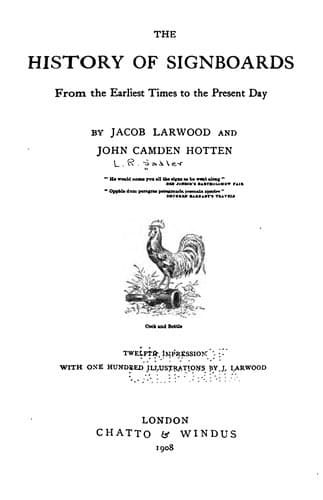
The History of Signboards, from the Earliest times to the Present DayHotten, John Camden
History
The History of Signboards, from the Earliest times to the Present Day
Hotten, John Camden
Inn signs -- England -- History; Signs and signboards -- History
The HOLLY BUSH is a common public-house sign at the present day. Among
the London trades tokens there is one of the HAND AND HOLLY BUSH at
Templebar, evidently the same inn mentioned in 1708 by Hatton, “on the
north side, and about the middle of the backside of St Clements, near
the church.”[360] This combination with the hand does not seem to have
any very distinct meaning, and apparently arose simply from the manner
of representing objects in those days, as being held by a hand issuing
from a cloud. Adorning houses and churches at Christmas with evergreens
and holly is a very ancient custom, supposed, like some others of our
old customs, to be derived from the Druids. Formerly the streets also
appear to have been decked out, for Stow tells us that
“Against the feast of Christmas every man’s house, as also the parish
churches, were decked with holme, ivy, and bayes, and whatsoever the
season of the year afforded to be given. The conduits and standards in
the streets were likewise garnished.”
Thus flowers, fruit trees, and forest trees were represented on the
signboard, and with them even the homely but useful tenants of the
kitchen garden found a place. The ARTICHOKE, above all, used to be a
great favourite, and still gives a name to some public-houses. As a
seedsman’s sign it was common and rational; not so for a milliner, yet
both among the Bagford and Banks’s shopbills there are several instances
of its being the sign of that business; thus:--
“Susannah Fordham, att the HARTICHOAKE, in ye Royal Exchange,” in the
reign of Queen Anne, sold “all sorts of fine poynts, laces, and
linnens, and all sorts of gloves and ribons, and all other sorts of
millenary wares.”[361]
Probably the novelty of the plant had more than anything else to do with
this selection; for though it was introduced in this country in the
reign of King Henry VIII., yet Evelyn observes:--
“‘Tis not very long since this noble thistle came first into Italy,
improved to this magnitude by culture, and so rare in England that
they were commonly sold for a crowne a piece.”[362]
Public-domain text, read in full here on John Shaqi.
Reviews
Reviews
No reviews yet
Be the first to share your thoughts on this work.
Elsewhere in the archive
Join the Discussion
Join the discussion
Sign in to leave a comment or review.
Sign InorCreate an account