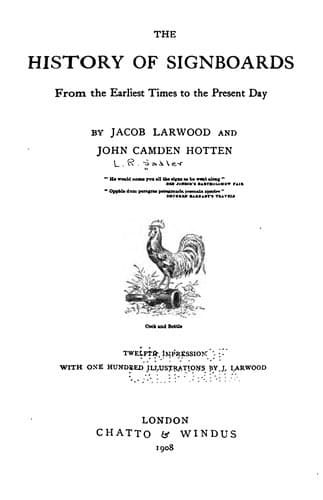
The History of Signboards, from the Earliest times to the Present DayHotten, John Camden
History
The History of Signboards, from the Earliest times to the Present Day
Hotten, John Camden
Inn signs -- England -- History; Signs and signboards -- History
[349] Curiously enough, until about 1820, a public-house, the sign of
the Vine, in Dobie Street, St Giles, occupied the very site assigned to
this vineyard in Domesday Book, A.D. 1070.
[350] Hollinshed’s Description of Britain, p. 3.
[351] Faulkner, Antiquities of Kensington.
[352] Grosley, vol. i., p. 83.
[353] He lived then in Exeter Street, at a stay-maker’s. Boswell’s
Johnson: London, 1819, p. 67.
[354] “In spring-time the fig-tree does not make any show of beautiful
flowers or precocious fruit to deceive mankind with idle hope; but in
autumn it generally produces exceedingly sweet fruit, with flowers as it
were contained within them.”--_Joachimus Camerarius_, “_Symbolorum
Centuriæ Quatuor_,” 1697, Centur. i., p. 18.
[355] “Among the many curious properties which the writers on natural
history attribute to the palm tree, it is not one of the least singular
that this tree cannot well thrive unless it be properly basked by the
beams of the sun, and watered by some neighbouring stream.”--_J.
Camerarius_, “_Centuria_,” i., 1697.
[356] Defoe’s Journey through England, p. 168.
[357] Horace Walpole’s Letters to Mr Mann, February 6, 1780.
[358] As quoted in Disraeli’s Curiosities of Literature, ii. p. 326.
[359] _Publick Advertiser_, Tuesday, June 16-22, 1657.
[360] Hatton’s New View of London, 1708, p. 36.
[361] Bagford Bills.
[362] Evelyn’s Miscellaneous Writings, p. 735.
[363] _Gent. Mag._, March 1842.
[364]
“Christ is represented here
After his death and resurrection,
As a great gardener
Whom every body must praise.
This is at the Three Radishes.”
[365]
“Adam and Eve lived in Paradise,
They rarely ate stock fish, but a great deal of hotchpotch, lettuce,
and radishes.
All sorts of vegetables sold here for human food.”
A similarly dull joke occurs in an old English comedy, “Law Tricks,” by
John Day, 1608. “I have heard old Adam was an honest man and a good
gardener, loved lettuce well, salads and cabbage reasonably well, yet no
tobacco.”
CHAPTER VIII.
BIBLICAL AND RELIGIOUS SIGNS.
Public-domain text, read in full here on John Shaqi.
Reviews
Reviews
No reviews yet
Be the first to share your thoughts on this work.
Elsewhere in the archive
Join the Discussion
Join the discussion
Sign in to leave a comment or review.
Sign InorCreate an account