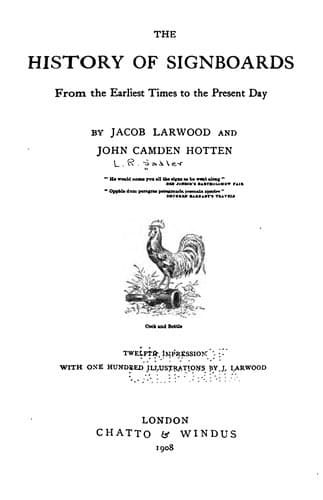
The History of Signboards, from the Earliest times to the Present DayHotten, John Camden
History
The History of Signboards, from the Earliest times to the Present Day
Hotten, John Camden
Inn signs -- England -- History; Signs and signboards -- History
The earlier signs were frequently representations of the most important
article sold in the shops before which they hung. The stocking denoted
the hosier, the gridiron the ironmonger, and so on. The early
booksellers, whose trade lay chiefly in religious books, delighted in
signs of saints, but at the Reformation the BIBLE amongst those classes,
to whom till then it had been a sealed book, became in great request,
and was sold in large numbers. Then the booksellers set it up for their
sign; it became the popular symbol of the trade, and at the present
moment instances of its use still linger with us. There was one day in
the year, St Bartholomew’s, the 24th of August, when their shops
displayed nothing but Bibles and Prayer-books. It is not impossible that
this may have been originally intended for a manifestation against
Popery, since it was the anniversary of the dreadful Protestant massacre
in Paris in 1572. The following, however, is the only allusion we have
met with relating to this custom:--“Like a bookseller’s shop on
Bartholomew day at London, the stalls of which are so adorned with
Bibles and Prayer-books, that almost nothing is left within but heathen
knowledge.”[366]
One of the last BIBLE signs was about twenty years ago, at a
public-house in Shire Lane, Temple Bar. It was an old established house
of call for printers.
The Bible being such a common sign, booksellers had to “wear their rue
with a difference,” as Ophelia says, and adopt different colours,
amongst which the BLUE BIBLE was one of the most common. “Prynne’s
Histrio-Mastrix” was “printed for Michael Sparke, and sold at the Blue
Bible, in Green Arbour Court, Little Old Bailey, 1632.” This blue
colour, so common on the signboard, was not chosen without meaning, but
on account of its symbolic virtue. Blue, from its permanency, being an
emblem of truth, hence Lydgate, speaking of Delilah, Samson’s mistress,
in his translation from Boccacio, (MS. Harl. 2251,) says--
“Insteade of _blew, which steadfaste is and clene_,
She weraed colours of many a diverse grene.”
It also signified piety and sincerity. Randle Holme[367] says--
“This colour, _blew_, doth represent the sky on a clear, sun-shining
day, when all clouds are exiled. Job, speaking to the busy searchers
of God’s mysteries, saith (Job xi. 17,) ‘That then shall the residue
of their lives be as clear as the noonday.’ Which to the judgment of
men (through the pureness of the air) is of _azure_ colour or light
_blew_, and signifieth _piety and sincerity_.”
Public-domain text, read in full here on John Shaqi.
Reviews
Reviews
No reviews yet
Be the first to share your thoughts on this work.
Elsewhere in the archive
Join the Discussion
Join the discussion
Sign in to leave a comment or review.
Sign InorCreate an account