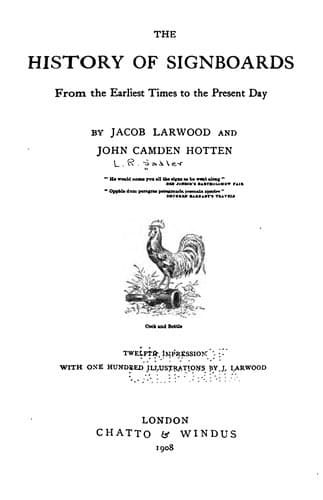
The History of Signboards, from the Earliest times to the Present DayHotten, John Camden
History
The History of Signboards, from the Earliest times to the Present Day
Hotten, John Camden
Inn signs -- England -- History; Signs and signboards -- History
The tree with the forbidden fruit, always represented in the sign of
Adam and Eve, leads directly to the FLAMING SWORD, “which turned every
way to keep the way of the tree of life.” Being the first sword on
record, it was not inappropriately a cutler’s sign, and as such we find
it in the Banks Collection, on the shop-bill of a sword cutler in
Sweeting’s Alley, Royal Exchange, 1780. It is less appropriate at the
door of a public-house in Nottingham, for the landlord evidently cannot
desire to keep anybody out, whether saint or sinner. The vessel by which
the life of the first planter of the vine was preserved, certainly well
deserves to decorate the tavern: hence NOAH’S ARK is not an uncommon
public-house sign, though it looks very like a sarcastic reflection on
the mixed crowd that resort to the house,--not to escape the “heavy
wet,” as the animals at the Deluge, but in order to obtain some of it.
Toy-shops also constantly use it, since Noah’s Ark is generally the
favourite toy of children. Evelyn, in 1644, mentions a shop near the
Palais de Justice in Paris:
“Here is a shop called Noah’s Ark, where are sold all curiosities,
natural or artificial, Indian or European, for luxury or use, as
cabinets, shells, ivory, porcelain, dried fishes, insects, birds,
pictures, and a thousand exotic extravagances.”[373]
The Deluge was one of the standard subjects of mediæval dramatic plays.
In the third part of the Chester Whitsun plays, for instance, Noah and
the Flood make a considerable item; and at a much later period the same
subject was exhibited at Bartholomew Fair. A bill of the time of Queen
Anne[374] informs us that--
“At Crawley’s Booth, over against the Crown Tavern in Smithfield,
during the time of Bartholomew Fair, will be presented a little Opera,
called the Old Creation of the World, yet newly revived, with the
addition of _Noah’s Flood_; also several fountains playing water
during the time of the play. The last scene presents Noah and his
family coming out of the Ark, with all the beasts, two by two, and all
the fowls of the air, seen in a prospect, sitting upon trees. Likewise
over the Ark is seen the sun rising in a most glorious manner:
moreover, a multitude of angels will be seen, in a double rank, which
presents a double prospect--one for the sun, the other for a palace,
where will be seen 6 angels ringing of bells, etc.”
Public-domain text, read in full here on John Shaqi.
Reviews
Reviews
No reviews yet
Be the first to share your thoughts on this work.
Elsewhere in the archive
Join the Discussion
Join the discussion
Sign in to leave a comment or review.
Sign InorCreate an account