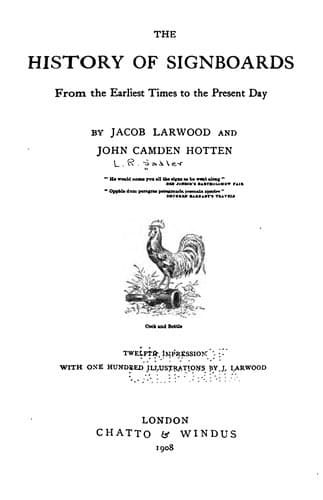
The History of Signboards, from the Earliest times to the Present DayHotten, John Camden
History
The History of Signboards, from the Earliest times to the Present Day
Hotten, John Camden
Inn signs -- England -- History; Signs and signboards -- History
Psalm xlii. seems to be very profanely hinted at in the sign of the
WHITE HART AND FOUNTAIN, Royal Mint Street, which, if not a combination
of two well-known signs, apparently alludes to the words, “As the hart
panteth after the water brooks, so panteth my soul after thee, O God.”
THE PANTING HART (_het dorstige Hert_, or _het Heigent Hert_,) was
formerly a very common beer-house sign in Holland. In the seventeenth
century there was one with the following inscription at Amsterdam:--
“Gelyk het hert by frisch water sig komt te verblyden,
Komt also in myn huys om u van dorst te bevryden.”[384]
Another one at Leyden had the following rhyme:--
“Gelyk een hart van jagen moe lust te drinken water rein,
Also verkoopt men hier tot versterking van de maag, toebak, bier en
Brandewyn.”[385]
The wise king Solomon does not appear to have ever been honoured with a
signboard portrait, but his enthusiastic admirer, the QUEEN OF SABA,
figured before the tavern kept by Dick Tarlton the jester, in
Gracechurch Street. This Queen of Saba, or Sheba, was a usual figure in
pageants. There is a letter of Secretary Barlow, in “Nugæ Antiquæ,”
telling how the Queen of Sheba fell down and upset her casket in the lap
of the King of Denmark--when on his drunken visit to James I.--who “got
not a little defiled with the presents of the queen; such as wine,
cream, jelly, beverages, cakes, spices, and other good matters.”
Douce, in his “Illustrations to Shakespeare,” has a very ingenious
explanation for the sign of the BELL SAVAGE, as derived from the QUEEN
OF SABA, which though _non è vero, ma ben trovato_. He bases his
argument on a poem of the fourteenth century, the “Romaunce of Kyng
Alisaundre,” wherein the Queen of Saba is thus mentioned:--
“In heore lond is a cité,
On of the noblest in Christianté,
Hit hotith Sabba in langage,
Thence cam _Sibely Savage_.
Of all the world the fairest queene,
To Jerusalem Salomon to seone.
For hire fair head and for hire love,
Salomon forsok his God above.”[386]
ELISHA’S RAVEN, represented with a chop in his mouth, is the sign of a
butcher in the Borough,--a curious conceit, and certainly his own
invention; at least we do not remember any other instance of the sign.
This tribute is certainly very disinterested in the butcher, for if
there were any such ravens now, it is probable that they would sadly
interfere with the trade.
Public-domain text, read in full here on John Shaqi.
Reviews
Reviews
No reviews yet
Be the first to share your thoughts on this work.
Elsewhere in the archive
Join the Discussion
Join the discussion
Sign in to leave a comment or review.
Sign InorCreate an account