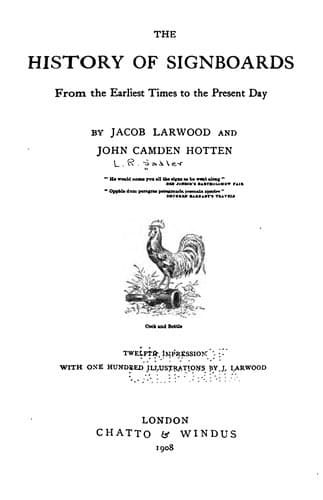
The History of Signboards, from the Earliest times to the Present DayHotten, John Camden
History
The History of Signboards, from the Earliest times to the Present Day
Hotten, John Camden
Inn signs -- England -- History; Signs and signboards -- History
After Moses there is a blank until we come to SAMSON, to whom our
national admiration for athletic sports and muscular strength has given
a prominent place on the signboard. SAMSON AND THE LION occurs on the
sign of various houses in London in the seventeenth century, as appears
from the trades tokens. It is still of frequent occurrence in country
towns, as at Dudley, Coventry, &c. It was also used on the Continent. In
Paris there is, or was, not many years ago, a _della Robbia_ ware
medallion sign in the Rue des Dragons, with the legend “_le Fort
Samson_,” representing the strong man tearing open the lion. To a sign
of SAMSON at Dordrecht, in the seventeenth century, the following
satirical inscription had been added:--
“Toen Samson door zyn kracht de leeuw belemmen kon,
De Philistynen sloeg, de vossen overwon.
Wiert hy nog door een Vrouw van zyn gezigt beroofd,
Gelooft geen vrouw dan of zy moet zyn zonder hoofd.”[382]
This admiration of strong men, which procured the signboard honours to
Samson, also made GOLIAH, or GOLIAS, a great favourite. In the Horse
Market, Castle Barnard, he is actually treated just like a duke,
admiral, or any other public-house hero, for there the sign is entitled
the GOLIAH HEAD. Some doubts, however, may be entertained whether by
Golias or Goliah, (for the name is spelt both ways,) the Philistine
giant and champion was always intended. Towards the end of the twelfth
century there lived a man of wit, with the real or assumed name of
Golias, who wrote the “Apocalypsis Goliæ,” and other burlesque verses.
He was the leader of a jovial sect called Goliardois, of which Chaucer’s
Miller was one. “He was a jangler and a goliardeis.” Such a person
might, therefore, have been a very appropriate tutelary deity for an
alehouse.[383]
Goliah’s conqueror, KING DAVID, liberally shared the honours with his
victim, and he still figures on various signboards. There is a KING
DAVID’S inn in Bristol, and a DAVID AND HARP in Limehouse; whilst in
Paris, the Rue de la Harpe is said to owe its name to a sign of King
David playing on the harp. David’s unfortunate son, ABSALOM, was a
peruke-maker’s very expressive emblem, both in France and in England, to
show the utility of wigs. Thus a barber at a town in Northamptonshire
used this inscription:
“ABSALOM, hadst thou worn a perriwig, thou hadst not been hanged.”
Which a brother peruke-maker versified, under a sign representing the
death of Absalom, with David weeping. He wrote up thus:
“Oh Absalom! oh Absalom!
Oh Absalom! my son,
If thou hadst worn a perriwig,
Thou hadst not been undone.”
Public-domain text, read in full here on John Shaqi.
Reviews
Reviews
No reviews yet
Be the first to share your thoughts on this work.
Elsewhere in the archive
Join the Discussion
Join the discussion
Sign in to leave a comment or review.
Sign InorCreate an account