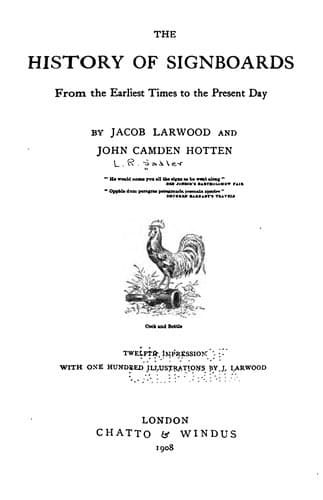
The History of Signboards, from the Earliest times to the Present DayHotten, John Camden
History
The History of Signboards, from the Earliest times to the Present Day
Hotten, John Camden
Inn signs -- England -- History; Signs and signboards -- History
The ANGEL was derived from the Salutation, for that it originally
represented the angel appearing to the Holy Virgin at the Salutation or
Annunciation, is evident from the fact that, even as late as the
seventeenth century on nearly all the trades tokens of houses with this
sign, the Angel is represented with a scroll in his hands; and this
scroll we know, from the evidence of paintings and prints, to contain
the words addressed by the angel to the Holy Virgin: “Ave Maria, gratia
plena, Dominus tecum.” Probably at the Reformation it was considered too
Catholic a sign, and so the Holy Virgin was left out, and the angel only
retained. Among the famous houses with this sign, the well-known
starting-place of the Islington omnibuses stands foremost. It is said to
have been an established inn upwards of two hundred years. The old house
was pulled down in 1819; till that time it had preserved all the
features of a large country inn, a long front, overhanging tiled roof,
with a square inn-yard having double galleries supported by columns and
carved pilasters, with caryatides and other ornaments. It is more than
probable that it had often been used as a place for dramatic
entertainments at the period when inn-yards were customarily employed
for such purposes. “Even so late as fifty years since it was customary
for travellers approaching London, to remain all night at the Angel Inn,
Islington, rather than venture after dark to prosecute their journey
along ways which were almost equally dangerous from their bad state, and
their being so greatly infested with thieves.”[388] On the other hand,
persons walking from the city to Islington in the evening, waited near
the end of John Street, in what is now termed Northampton Street, (but
was then a rural avenue planted with trees,) until a sufficient party
had collected, who were then escorted by an armed patrol appointed for
that purpose. Another old tavern with this sign is extant in London,
behind St Clement’s Church in the Strand. To this house Bishop Hooper
was taken by the Guards, on his way to Gloucester, where he went to be
burnt, in January 1555. The house, until lately, preserved much of its
ancient aspect: it had a pointed gable, galleries, and a lattice in the
passage. This inn is named in the following curious advertisement:--
“To be sold, a Black Girl, the property of J. B----, eleven years of
age, who is extremely handy, works at her needle tolerably, and speaks
French perfectly well; is of excellent temper and willing disposition.
Inquire of W. Owen, at the _Angel Inn_, behind St Clement’s Church, in
the Strand.”--_Publick Advertiser_, March 28, 1769.
Public-domain text, read in full here on John Shaqi.
Reviews
Reviews
No reviews yet
Be the first to share your thoughts on this work.
Elsewhere in the archive
Join the Discussion
Join the discussion
Sign in to leave a comment or review.
Sign InorCreate an account