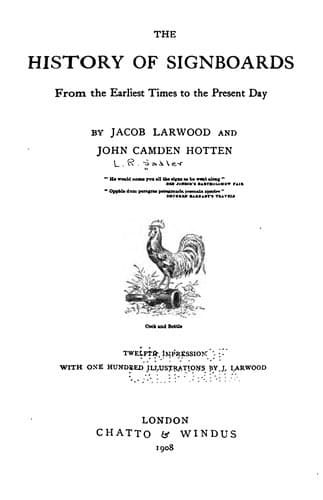
The History of Signboards, from the Earliest times to the Present DayHotten, John Camden
History
The History of Signboards, from the Earliest times to the Present Day
Hotten, John Camden
Inn signs -- England -- History; Signs and signboards -- History
Older than either of these is the Angel Inn, at Grantham. This building
was formerly in the possession of the Knights Templars, and still
retains many remains of its former beauty, particularly the gateway,
with the heads of Edward III. and his queen Philippa of Hainault on
either side of the arch; the soffits of the windows are elegantly
groined, and the parapet of the front is very beautiful. Kings have been
entertained in this house; but it seemed to bring ill luck to them, for
the reigns of those that are recorded as having been guests in it, stand
forth in history as disturbed by violent storms--King John held his
court in it on February 23, 1213; King Richard III. on October 19, 1483;
and King Charles I. visited it May 17, 1633.
Ben Jonson, it is said, used to visit a tavern with the sign of the
Angel, at Basingstoke, kept by a Mrs Hope, whose daughter’s name was
Prudence. On one of his journeys, finding that the house had changed
both sign and mistresses, Ben wrote the following smart but not very
elegant epigram:--
“When _Hope_ and _Prudence_ kept this house, the _Angel_ kept the
door,
Now _Hope_ is dead, the _Angel_ fled, and _Prudence_ turned a w----.”
The Angel was the sign of one of the first coffee-houses in England, for
Anthony Wood tells us that, “in 1650 Jacob, a Jew, opened a coffee-house
at the Angel, in the parish of St Peter, Oxon; and there it [coffee] was
by some, who delight in noveltie, drank.” Finally, there was an Angel
Tavern in Smithfield, where the famous Joe Miller, of joking fame--a
comic actor by profession--used to play during Bartholomew Fair time. A
playbill of 1722 informs the public in large letters that--
“MILLER is not with PINKETHMAN, but by himself, AT THE ANGEL TAVERN,
next door to the King’s Bench, who acts a new Droll, called the
FAITHFUL COUPLE OR THE ROYAL SHEPHERDESS, with a very pleasant
entertainment between OLD HOB and his WIFE, and the comical humours of
MOPSY and COLLIN, with a variety of singing and dancing.
“The only Comedian now that dare,
Vie with the world and challenge the Fair.”
In France, also, the sign of the Angel is and was at all times, very
common. The Hotel de _l’Ange_, Rue de la Huchette, appears to have been
the best hotel in Paris in the sixteenth century. It was frequently
visited by foreign ambassadors: those sent by Emperor Maximilian to
Louis XII. took up their abode here; so did the ambassadors from Angus,
King of Achaia, who, in 1552, came to see France, much in the same way
as various ambassadors from all sorts of high and low latitudes
occasionally honour our Court with a visit. Chapelle, a French poet of
the seventeenth century, thus celebrates a tavern with this sign in
Paris, frequented by the wits of the period:--
“Je n’ay pas vu vostre theâtre
Qu’aussitot je ressors de là,
Pour un Ange que j’idolâtre,
A cause du bon vin qu’il a.”[389]
Public-domain text, read in full here on John Shaqi.
Reviews
Reviews
No reviews yet
Be the first to share your thoughts on this work.
Elsewhere in the archive
Join the Discussion
Join the discussion
Sign in to leave a comment or review.
Sign InorCreate an account