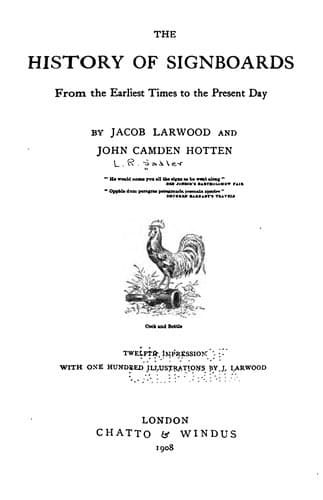
The History of Signboards, from the Earliest times to the Present DayHotten, John Camden
History
The History of Signboards, from the Earliest times to the Present Day
Hotten, John Camden
Inn signs -- England -- History; Signs and signboards -- History
The prevalence of the BAPTIST’S HEAD probably dated from the time when
pilgrimages across the sea were considered good works, and the head of
St John the Baptist at Amiens Cathedral came in for a large share of
visits from English worshippers. The old monkish writers say that in 448
after Christ, the head was found in Jerusalem; in 1206 it was
transferred to Amiens, where it was kept in a salver of gold, surrounded
with a rim of pearls and precious stones.[396] Various other reasons may
be adduced for the prevalence of this sign, as the conspicuous place
occupied by St John in the Roman Catholic hagiology, and hence in
mediæval plays and mysteries; the festivities of Midsummer, (a day of
great moment in London for setting the watch;) and, finally, his being
the patron saint of the Knights of Jerusalem. It was doubtless in
compliment to those knights that the Baptist’s Head in St John’s Lane,
Clerkenwell, was named. This house seems to be the remainder of some
noble mansion of Queen Elizabeth’s time; it contains many Elizabethan
ornaments, particularly a chimney-piece, with the coats of arms of the
Radcliff and Forster families. When the house was adapted to its present
purpose, it was distinguished by the head of St John the Baptist in a
charger, now gone. Doctor Johnson is said to have been an occasional
visitor here, when returning from Edward Cave’s, the editor of the
_Gentleman’s Magazine_, whose office was close by at St John’s Gate.
Goldsmith is also reported to have made frequent calls here, when
business of a similar nature led him to the same spot. In later years it
became the _house of call_ of the prisoners on their way to the new
prison in the parish--a circumstance commemorated by Dodd in the “Old
Bailey Registers.” Another St John’s Head is mentioned by Stow in the
following accident:--
“The 11th of July (1553) Gilbert Pot, drawer to Ninion Saunders,
vintner, dwelling at St John’s Head within Ludgate, who was accused by
the said Saunders, his maister, was set on the pillory in Cheape, with
both his ears nailed and cleane cut off, for wordes speaking at the
time of the proclamation of Lady Jane; at which execution was a
trumpet bloune and a herault in his coat of armes redd his offence, in
presence of William Garrard, one of the Sheriffes of London. About 5
of the clocke the same day, in the afternoone, Ninion Saunders, master
to the said Gilbert Pot, and John Owen, a gunmaker, both gunners of
the Tower, comming from the Tower of London by water in a whirrie and
shooting London Bridge, towards the Black Fryers, were drowned at S.
Mary Loch[397] and the whirry-man saved by their oars.”
To this same saint also refers the JOHN OF JERUSALEM, a sign at the
present day in Rosoman Street, Clerkenwell, put up, like the Baptist
Head, in remembrance of the Knights of St John of Jerusalem, who
formerly had their priory in this locality.
Public-domain text, read in full here on John Shaqi.
Reviews
Reviews
No reviews yet
Be the first to share your thoughts on this work.
Elsewhere in the archive
Join the Discussion
Join the discussion
Sign in to leave a comment or review.
Sign InorCreate an account