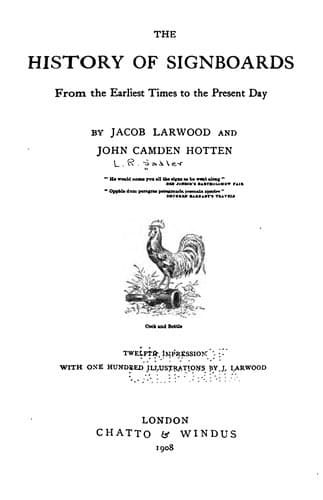
The History of Signboards, from the Earliest times to the Present DayHotten, John Camden
History
The History of Signboards, from the Earliest times to the Present Day
Hotten, John Camden
Inn signs -- England -- History; Signs and signboards -- History
The ANGEL AND SUN, apparently a combination of two signs, is named as a
shop or tavern near Strandbridge, in 1663,[394] and is still the name of
a public-house in the Strand. The ANGEL AND WOOLPACK, at Bolton, is the
same sign which, near London Bridge, is called the NAKED BOY AND
WOOLPACK. A woolpack, with a negro seated on it, was at one time very
common; for a change or distinction, this negro underwent the reputed
impossible process of being washed white, and thus became a naked boy,
which, in signboard phraseology, is equivalent to an angel.
The VIRGIN was unquestionably a very common sign before the Reformation,
and it may be met with even at the present day, as, for instance, at
Ebury Hill, Worcester, and in various other places. In France it was,
and is still, much more common than in England, as might be expected.
Tallemant des Réaux tells of a miraculous tavern sign of NOTRE DAME, on
the bridge of that name, in Paris, which was observed by the faithful to
cry and shed tears, probably on account of the bad company she had to
harbour. It was taken down by order of the archbishop. At the end of the
seventeenth century there was, in the Rue de la Seine, Paris, a quack
doctor, who pretended to cure a great variety of complaints. He put up a
holy Virgin for his sign, with the words, “REFUGIUM PECCATORUM,” which
is one of the usual epithets of the holy Virgin in the Roman Catholic
Church service, very wittily, although profanely, applied in this
instance. The sign of the Virgin was also called OUR LADY, as: “Newe
Inne was a guest Inne, the sign whereof was the picture of our Lady, and
thereupon it was also called _Our Lady’s_ Inne.”[395] OUR LADY OF PITY
was the sign of Johan Redman, a bookseller in Paternoster Row, in 1542.
Johan Byddell, also a bookseller, had introduced this sign in the
beginning of that century. This Byddell, or Bedel, (who lived in Fleet
Street, next to Fleet Bridge,) had evidently borrowed it from a nearly
similar figure in Corio’s History of Milan, 1505. He afterwards lived at
the SUN, in Fleet Street, the house formerly occupied by Wynkyn de
Worde.
Public-domain text, read in full here on John Shaqi.
Reviews
Reviews
No reviews yet
Be the first to share your thoughts on this work.
Elsewhere in the archive
Join the Discussion
Join the discussion
Sign in to leave a comment or review.
Sign InorCreate an account