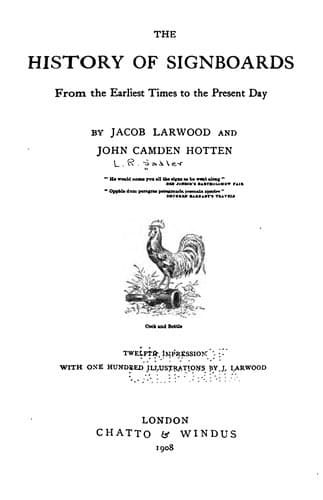
The History of Signboards, from the Earliest times to the Present DayHotten, John Camden
History
The History of Signboards, from the Earliest times to the Present Day
Hotten, John Camden
Inn signs -- England -- History; Signs and signboards -- History
“They report in Paris that the Thorny Crown, wherewith Christ was
crowned on the Crosse, is kept in the Palace, which vpon Corpus
Christi Day, in the afternoone, was publickly shewed, as some told me;
but it was not my chance to see it. Truely, I wonder to see the
contrarieties amongst the Papists, and most ridiculous varieties
concerning their reliques, but especially about this of Christ’s
Thorny Crowne. For whereas I was after that at the Citie of Vicenza in
Italy, it was told me that in the monastery of the Dominican Fryers of
that Citie, this Crowne was kept, which Saint Lewes, King of France,
bestowed upon his brother Bartholomew, Bishop of Vicenza, and before
one of the Dominican family. Wherefore I went to the Dominican
Monastery and made suit to see it, but I had the repulse; for they
told me that it was kept vnder three or four lockes, and neuer shewed
to any by any favour whatsoeuer, but only upon Corpus Christi Day. If
this Crowne of Paris, whereof they so much bragge, be true, that of
Vicenza is false. Ho! the truth and certainty of Papistical
reliques.”[400]
CROSSES of various colours were probably amongst the first signs put up
by the newly-converted Christians, (as soon as they could effect this
with impunity,) on account of the recommendation of the early fathers,
and for their beneficial influence. Father Lactantius, who lived in the
fourth century, writes--“As Christ, whilst He lived amongst men, put the
devils to flight by His words, and restored those to their senses whom
these evil spirits had possessed; so now His followers in the name of
their Master, and by the sign of His passion, even exercise the same
dominion over them.” St Ephrem says--“_Let us paint and imprint on our
doors_ the life-giving cross; thus defended no evil will hurt you.” St
Chrysostom says the same--“_Wherefore let us with earnestness impress
this cross on our houses, and on our walls, and our windows._” St Cyril
of Alexandria introduces the Emperor Julian the apostate saying, “You
Christians adore the wood of the cross, _you engrave it on the porches
of your houses_,” &c. Hence the still prevalent custom in Roman Catholic
places of painting crosses on the walls of houses, to drive away
witches, as it is said; and these crosses being painted in different
colours, might easily serve as a sign by which to designate the house.
At the Crusades the popularity of this emblem increased: a red cross was
the badge of the Crusader, and would be put up as a sign by men who had
been to the Holy Land, or wished to court the patronage of those on
their way thither. Finally, the different orders of knighthood settled
each upon a particular colour as their distinctive mark. Thus the
knights of St John wore _white crosses_, the Templars _red crosses_, the
knights of St Lazarus _green crosses_, the Teutonic knights _black
crosses_, embroidered with gold, &c. But the most common in England was
Public-domain text, read in full here on John Shaqi.
Reviews
Reviews
No reviews yet
Be the first to share your thoughts on this work.
Elsewhere in the archive
Join the Discussion
Join the discussion
Sign in to leave a comment or review.
Sign InorCreate an account