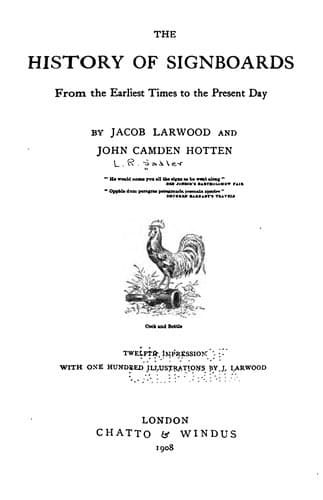
The History of Signboards, from the Earliest times to the Present DayHotten, John Camden
History
The History of Signboards, from the Earliest times to the Present Day
Hotten, John Camden
Inn signs -- England -- History; Signs and signboards -- History
the _red cross_, which was the cross of St George, and also of the red
cross knights, who acted as a sort of police on the roads between Europe
and the Holy Land to protect pilgrims. This badge, therefore, could not
fail to be very popular.
In France it used to be, and in all probability is still, a common rebus
to see _le signe de la croix_ represented by a swan with a cross on his
back, (_cygne de la croix_.)
Only very few signs of the cross are now remaining. The GOLDEN CROSS in
the Strand is one of these, and has been in that locality for centuries.
It was one of the first upon which the Puritans brooked their ill-humour
and hatred of popery; for in 1643 it was taken down by order of a
committee from the House of Commons, as “superstitious and idolatrous.”
This was the precursor of the fall of old Charing Cross itself. The
sign, however, was put up again at the Restoration, and figures
prominently in Canaletti’s well-known view of Charing Cross, in the
Northumberland Collection. The tavern was probably pulled down at the
formation of Trafalgar Square.
At a point on the road between Dunchurch and Daventry, where three roads
meet, there was formerly an inn with the sign of the THREE CROSSES, in
allusion to the three roads. Swift, in one of his pedestrian excursions,
happened to stop at that inn. Not being very elegantly dressed, and
rather importunate to be served, the landlady told him that she could
not leave her customers for “such as he,” upon which the Dean, who was
not the most modest, nor the most patient of men, wrote the following
epigram on one of the windows:--
“TO THE LANDLORD.
There hang three crosses at thy door,
Hang up thy wife and she’ll make four.”
Public-domain text, read in full here on John Shaqi.
Reviews
Reviews
No reviews yet
Be the first to share your thoughts on this work.
Elsewhere in the archive
Join the Discussion
Join the discussion
Sign in to leave a comment or review.
Sign InorCreate an account