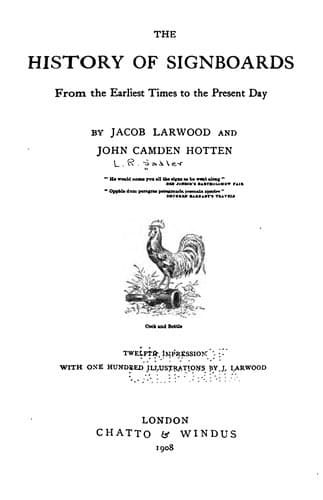
The History of Signboards, from the Earliest times to the Present DayHotten, John Camden
History
The History of Signboards, from the Earliest times to the Present Day
Hotten, John Camden
Inn signs -- England -- History; Signs and signboards -- History
Although the English ale and refreshment houses continue to select fresh
signs from the notabilities of the hour, the Palmerston’s Head and the
Gladstone Arms for instance, they rarely choose anything of a religious
or devotional cast. One instance, however, occurs to us, and that in the
neighbourhood of London, which deserves mention. In Kentish Town, under
the Hampstead hills, the noisiest and most objectionable public-house in
the district bears the significant sign of the GOSPEL OAK. It is the
favourite resort of navvies and quarrelsome shoemakers, and took its
name, not from any inclination to piety on the part of the landlord, but
from an old oak tree in the neighbourhood, near the boundary line of
Hampstead and St Pancras parishes, a relic of the once general custom of
reading a portion of the gospel under certain trees in the parish
perambulations, equivalent to “beating the bounds.” “The boundaries and
township of the parish of Wolverhampton are,” says Shaw, in his “History
of Staffordshire,” (vol. ii., p. 165,) “in many points marked out by
what are called _Gospel Trees_;” and Herrick, in his “Hesperides,” (Ed.
1859, p. 26,) says:--
“Dearest, bury me
Under that _holy oak_, or _gospel tree_;
Where, though thou see’st not, thou may’st think upon
Me, when _thou yeerly go’st procession_.”
The old Kentish Town Gospel Oak was removed a short time since, but not
until it had given a name to the surrounding fields, to a village, (Oak
village,) and to a chapel, as well as to the public-house alluded to.
[366] New Essays and Characters, by John Stephens the younger, of
Lincoln’s Inn, Gent. London, 1631, p. 221.
[367] Randle Holme, “Academy of Armour and Blazon,” p. 52.
[368] _Postman_, Feb. 1-3, 1711.
[369] “Notandum quoq. eius (pavonis) carnem quod D. Augustinus quoq.,
lib. xxi. de civitate Dei, cap. iii., et Isidorus, lib. xii., affirmant
non putrescere.”--_Camerarius, Centur._, iii. 20, 1697. How to make this
agree with Skelton’s idea it is not very easy to explain--
“Then sayd the Pecocke,
All ye well wot,
I sing not musycal,
For my breast is decay’d.”--_Skelton’s Armory of Birds._
[370] See Fosbrooke’s Encyclopædia of Antiquities, vol. ii., p. 673.
[371] For particulars of Topham, the Strong Man, see under HISTORICAL
SIGNS.
[372] This statement is made on the authority of Hone, in his “Ancient
Mysteries.” Doubts, however, have been expressed as to the accuracy of
his data upon this particular subject.
[373] Diary of John Evelyn, Feb. 3, 1684.
[374] Bagford Collection, Bib. Harl., 5931.
[375]
“The wood is cut in order to be burned,
Therefore is this Abraham’s sacrifice.”
[376] JACOB’S INN is mentioned by Hatton, 1708, “on the east side of Red
Cross Street near the middle.”
[377] “Amusements for the Meridian of London,” 1706.
[378]
Public-domain text, read in full here on John Shaqi.
Reviews
Reviews
No reviews yet
Be the first to share your thoughts on this work.
Elsewhere in the archive
Join the Discussion
Join the discussion
Sign in to leave a comment or review.
Sign InorCreate an account