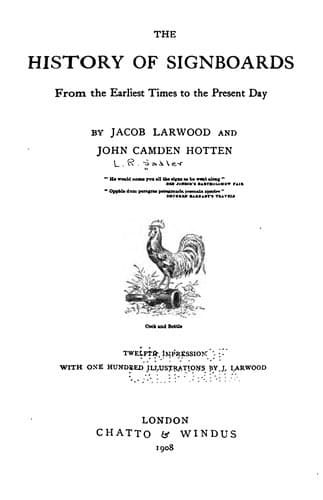
The History of Signboards, from the Earliest times to the Present DayHotten, John Camden
History
The History of Signboards, from the Earliest times to the Present Day
Hotten, John Camden
Inn signs -- England -- History; Signs and signboards -- History
Many of these saints were patrons of particular trades, and were
constantly adopted as the signs of those that followed them. Thus ST
CRISPIN was generally a shoemaker’s sign. At the present day, the gentle
craft represented by this saint live up to the proverb, and keep to the
“last;” but many publicans still have the sign of CRISPIN, SAINT
CRISPIN, JOLLY CRISPIN, or CRISPIN AND CRISPIAN, and occasionally KING
CRISPIN, (as at Morpeth.) And well may they put their houses under the
protection of this saint, since the proverb says, “_Cobblers_ and
tinkers are the best ale drinkers.” Crispin and Crispian were two Roman
brothers, sons of a king; they travelled to France to preach
Christianity, and worked at the trade of shoemakers, making sandals for
the poor, which they gave away, the angels supplying them with leather.
Hence they are considered the patrons of shoemakers. They were beheaded
at Soissons in 308. What may have contributed to their popularity in
this country is the fact of the battle of Agincourt having been fought
on their day, October 25, 1415:--
“And Crispin Crispian shall never go by
From this day to the ending of the world,
But we in it shall be remember’d,
We few, we happy few, we band of brothers,
For he to-day that sheds his blood with me
Shall be my brother; be he ne’er so vile,
This day shall gentle his condition,
And gentlemen in England now a-bed
Shall think themselves accurs’d they were not here,
And hold their manhoods cheap, while any speaks
That fought with us upon St Crispin’s day.”
_Henry the Fifth_, iv. 3.
From Shakespeare we turn to the homely rhymes of a Dutch shoemaker at
the Hague, who, in the seventeenth century, had this couplet over his
door:--
“Dit is Sint Crispyn, maar ik hiet Stoffel,
Ik maak een laars, schoen en pantoffel.”[405]
A more spirited one about the same time was in Bergen op Zoom, which is
not bad satire for a Dutchman:--
“Hier in Krispyn kan men de mensch uit beestevellen
Elk schoenen na zyn voet voor gelt terstond bestellen,
Doch menig beest alheir steekt in een menschevel,
Draagt zelf zyn broeder’s huid en ’t staat dat beest nog wel.”[406]
The ST HUGH’S BONES was another sign of the gentle craft; it seems to be
extinct now, but a trades token shows that, in 1657, it was the sign of
a house in Stanhope Street, Claremarket. From a little chapbook,
entitled,--
“The Delightful, Princely, and Entertaining History of the Gentle
Craft, &c. London printed for J. Rhodes, at the corner of Bride Lane,
in Fleet Street, 1725,”
Public-domain text, read in full here on John Shaqi.
Reviews
Reviews
No reviews yet
Be the first to share your thoughts on this work.
Elsewhere in the archive
Join the Discussion
Join the discussion
Sign in to leave a comment or review.
Sign InorCreate an account