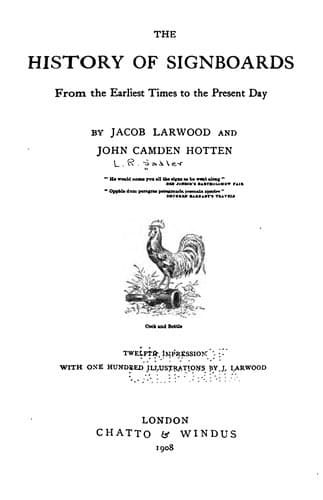
The History of Signboards, from the Earliest times to the Present DayHotten, John Camden
History
The History of Signboards, from the Earliest times to the Present Day
Hotten, John Camden
Inn signs -- England -- History; Signs and signboards -- History
we gather that Saint Hugh was a prince’s son,[407] deeply in love with a
saintly coquette called Winifred. Having been jilted by this lady in a
very pious manner, he went travelling, resisted the temptations of
Venice,[408] like another St Anthony, passed through numberless
adventures, compared to which those of Baron Munchausen sink into
insignificance, and was finally, by a jumble of most amusing
anachronism, martyred in the reign of Diocletian, by being made to drink
a cup of the blood of his lady-love, mixed with “cold poison,” after
which, his body was hung on the gallows. But among other misfortunes in
his travels, he had been shipwrecked and lost all his wealth, so that he
had to choose a profession, which was that of shoemaker, and so well he
liked his fellow-workmen that, having nothing else to give, he
bequeathed his bones to them. After they had been “well picked by the
birds,” some shoemakers took them from the gallows, and made them into
tools, and hence their tools were named St Hugh’s Bones. They are
specified in the following rhyme, which appears to have been the
shoemakers’ shibboleth:--
“My friends, I pray, you listen to me,
And mark what Saint Hugh’s Bones shall be:
First a Drawer and a Dresser,
Two Wedges, a more and a lesser.
A pretty Block, Three Inches high,
In fashion squared like a die;
Which shall be called by proper name
A Heelblock, ah! the very same;
A Handleather and a Thumbleather likewise,
To put on Shooe-thread we must devise;
The Needle and the Thimble shall not be left alone,
The Pinchers, the Pricking Awl, and Rubbing Stone;
The Awl, Steel and Jacks, the Sowing Hairs beside,
The Stirrop holding fast, while we sow the Cow hide;
The Whetstone, the Stopping Stick, and the Paring Knife,
All this does belong to a Journeyman’s Life:
Our Apron is the shrine to wrap these Bones in,
Thus shroud we S. Hugh’s Bones in a gentle lamb’s skin.
“Now you good Yeomen of the Gentle Craft,” the story goes on, “tell me
(quoth he) how like you this? As well (replied they) as Saint George
does of his horse: for as long as we can see him fight the Dragon, we
will never part with this poesie. And it shall be concluded, That what
journeyman soever he be hereafter that cannot handle his Sword and
Buckler, his long Sword and Quarterstaff, sound the Trumpet, or play
upon the Flute, or bear his part in a Three Man’s song, and readily
reckon up his Tools in Rhime, (except he have borne colours in the
Field, being a Lieutenant, a Sergeant or Corporal,) shall forfeit and
pay a Bottle of Wine, or be counted a Colt; to which they answered all
_viva voce_, Content, Content. And then, after many merry songs, they
departed. And never after did they travel without these tools on their
backs, which ever since have been called Saint Hugh’s Bones.”
Public-domain text, read in full here on John Shaqi.
Reviews
Reviews
No reviews yet
Be the first to share your thoughts on this work.
Elsewhere in the archive
Join the Discussion
Join the discussion
Sign in to leave a comment or review.
Sign InorCreate an account