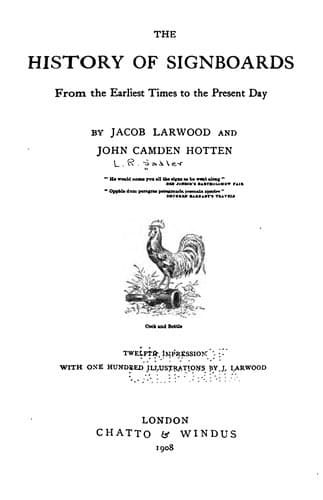
The History of Signboards, from the Earliest times to the Present DayHotten, John Camden
History
The History of Signboards, from the Earliest times to the Present Day
Hotten, John Camden
Inn signs -- England -- History; Signs and signboards -- History
“To save a mayd St George the Dragon slew--
A pretty tale, if all is told be true.
Most say there are no dragons, and ’tis sayd
There was no George; pray God there was a mayd.”
St George is mentioned by Bede, who calls the 23d of April “Natale S.
Georgii Martyris.” He was, however, at that time a very recent
importation, for Adamnanus (690), who lived just before Bede, says,
speaking of Arnulphus after his return from the East: “Etiam nobis de
quodam martyre Georgio nomine narrationem contulit.” In the reign of
Canute, there was already a house of regular canons sacred to St George
at Thetford, in Norfolk. The church of St George, Southwark, is also
thought to have existed before the Conqueror. But after the Conquest,
chapels were frequently erected to him, and on the seals of this period
he is often represented without the Dragon. Edward III. had a particular
veneration for him. Many of his statutes begin: “Ad honorem omnipotentis
Dei, Sanctæ Mariæ Virginis gloriosæ, et Sancti Georgii Martyris.” It was
after the foundation of the Order of the Garter that it became such a
favourite sign. The fact that he was the patron of soldiers also
assisted his popularity on the signboard.
There still exists an old and much dilapidated stone sign of St George
and the Dragon in the front of a house on Snowhill. Frequently this sign
is abbreviated to the GEORGE. There was an inn of this name, mentioned
in 1554 as being situate on the north side of the TABARD. This inn was
very much damaged by the great fire of Southwark in 1670, and completely
burned down in 1676. But it was rebuilt, and has come down to our time.
Machyn, in his Diary, mentions several _Georges_; one of them in
connexion with an occurrence which gives a good view of these lawless
times:--
“The viij day of December 1559 was the day of the Conception of owre
Lade was a grett fyre in the Gorge in Bred stret; itt begane at vj of
the cloke at nyght and dyd gret harm to dyvers houses. The 9th of
December cam serten fellows unto the Gorge in Bred stret where the
fyre was and gutt into the howse and brake up a chest of a clothear
and toke owt xl. lb. and after cryd _fyre_, _fyre_, so that ther cam
ijc pepull, and so they took one.”
The _George_ in Lombard Street was a very old house, once the town
mansion of the Earl Ferrers, in which one of that family was murdered as
early as 1175, (see Stow.) At this house died, in 1524, Richard Earl of
Kent, who had wasted his property in gaming and extravagance; it was
then an inn, where the nobility used to put up at. George Dowdall,
Archbishop of Armagh, (1558,) was buried from this house. Finally, we
may mention a _George Inn_ at Derby, in connexion with the following
advertisement from the _Daily Advertiser_, Oct. 1758:--
Public-domain text, read in full here on John Shaqi.
Reviews
Reviews
No reviews yet
Be the first to share your thoughts on this work.
Elsewhere in the archive
Join the Discussion
Join the discussion
Sign in to leave a comment or review.
Sign InorCreate an account