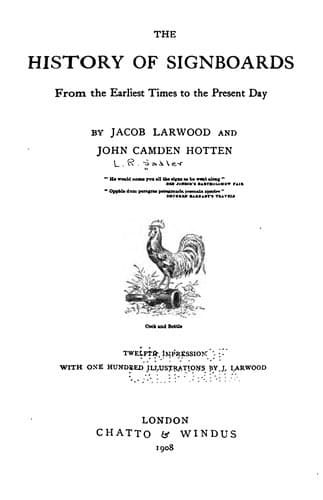
The History of Signboards, from the Earliest times to the Present DayHotten, John Camden
History
The History of Signboards, from the Earliest times to the Present Day
Hotten, John Camden
Inn signs -- England -- History; Signs and signboards -- History
The house in which this joke was perpetrated is enumerated by Stowe
amongst the principal inns of Southwark.
ST LUKE still figures as the sign of two or three public-houses in
London. Being the patron of painters, it certainly was the least the
sign-painters could do to honour his portrait with an occasional
appearance on the signboard. Yet it must be confessed St Luke was but a
sorry hand at painting. There is a portrait of the Holy Virgin painted
by him preserved in the Church of Silivria, on the shores of the Sea of
Marmora; but such a daub! the most modest village sign-painter would be
ashamed of the production. Yet, for all that, the thing works miracles,
and the only wonder is that its first effort in this line was not to
change itself into a good picture. We wonder at the Virgin, too, and
expected better from her taste; for in Valencia Cathedral there is
another portrait of her painted by Alonzo Cano, which is one of the most
lovely female heads we ever had the happiness to gaze upon. And so well
pleased was the Holy Virgin with this likeness, that she deigned to
descend from heaven to compliment the blessed artist upon his work. So
says the legend, and so the old beadle tells the travellers. But Luke
possessed other attributes. Aubrey tells us: “At Stoke Verdon, in the
Parish of Broad Chalke, was a chapell (in the chapell close by the
farm-house) dedicated to Saint Luke, _who is the Patron_ or Tutelar
_Saint of the Horne Beasts, and those that have to do with them_,”
&c.[415] This arose evidently from the Ox being his emblem, as the Lion
was of St Mark, the Eagle of St John, and the Angel of St Matthew. For
this reason St Luke was doubtless often chosen as the sign of inns
frequented by farmers and graziers.
SIMON THE TANNER OF JOPPA is an old-established house in Long-lane,
Bermondsey, and, as a sign, is supposed to be unique. It seems to have
been adopted with reference to the tanners, who frequented the house, or
it may have been the former occupation of the landlord, who gave the
sign to his house. Simon is named in Acts x. 32, “Send therefore to
Joppa, and call hither Simon, whose surname is Peter; he is lodged in
the house of one Simon a tanner, by the sea-side.”
But of all the signs coming under this class, SAINT GEORGE AND THE
DRAGON is undoubtedly the greatest favourite in England, and it is
equally well represented in other countries; for of this saint may be
said what Velleius Paterculus said about Pompey: “Quot partes terrarum
sunt, tot fecit monumenta victoriæ suæ.” In London alone there are at
present not less than sixty-six public-houses and taverns with this
name, not counting the beer-houses, coffee-houses, &c. Yet, after all,
it is very doubtful if St George ever existed, and he may be only a
popular corruption of St Michael conquering Satan, or Perseus’ romantic
delivery of Andromeda. Hence the little rhyme recorded by Aubrey, and
various other seventeenth century collectors of ana:
Public-domain text, read in full here on John Shaqi.
Reviews
Reviews
No reviews yet
Be the first to share your thoughts on this work.
Elsewhere in the archive
Join the Discussion
Join the discussion
Sign in to leave a comment or review.
Sign InorCreate an account