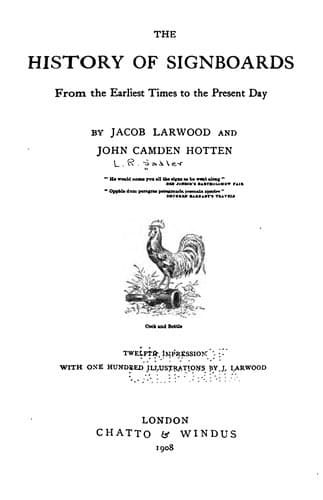
The History of Signboards, from the Earliest times to the Present Day — John Shaqi
The History of Signboards, from the Earliest times to the Present DayHotten, John Camden
History
The History of Signboards, from the Earliest times to the Present Day
Hotten, John Camden
Inn signs -- England -- History; Signs and signboards -- History
Besides these, there are, and have been at various times, excellent
signboards in Paris, the artists of which are not known. Thus there was,
in the beginning of the eighteenth century, a sign at the foot of the
Pont Neuf, called _le Petit Dunkerque_, which was greatly admired; and
in the reign of Louis XV. an armourer on the Pont Saint Michel had a
sign, which was so fine a work of art that it was bought as a cabinet
picture by a wealthy citizen. In the beginning of this century there was
a much admired sign on the shutters of a glass and china shop in the Rue
Royale St Honoré, which unfortunately was destroyed during some repairs
that took place upon the building passing into other hands. In 1808, the
sign of _la Fille mal gardée_, (a vaudeville,) at a mercer’s, attracted
great attention. About this period the Rue Vivienne was very rich in
good signboards; there were _la Toison de Cachemire_; _les Trois
Sultanes_; _le Couronnement de la Rosière_, and _la Joconde_, all very
good works of art. There was a gay _Comte Ory_ on the Boulevard des
Italiens, and _la Blanche Marguerite_, most comely to look upon, in the
Rue Montmartre. All these are now gone, but many good specimens of
French signboard painting may yet be met with.
Before closing this general survey of signboard history, we must direct
attention to the number of streets named after signs, both in England
and abroad. A walk down Fleet Street will give, in a small compass, as
many illustrations as are to be met with in any other thoroughfare in
town, for there nearly all the courts are named after signs that were
either hung within them, or at their entrance. Not only streets, but
families also have to thank signs for their names.
“Many names that seem unfitting for men, as of brutish beasts, etc.,
come from the very signes of the houses where they inhabited; for I
have heard of them which sayd they spake of knowledge, that some in
late time dwelling at the signe of the Dolphin, Bull, White Horse,
Racket, Peacocke, etc., were commonly called Thomas at the Dolphin,
Will at the Bull, George at the White Horse, Robin at the Racket,
which names, as many other of like sort, with omitting _at the_,
became afterwards hereditary to their children.”--CAMDEN’S _Remaines_,
p. 102.
As examples of such names we have, “Arrow, Axe, Barrell, Bullhead, Bell,
Block, Board, Banner, Bowles, Baskett, Cann, Coulter, Chisell, Clogg,
Crosskeys, Crosier, Funnell, Forge, Firebrand, Grapes, Griffin, Horns,
Hammer, Hamper, Hodd, Harrow, Image, (the sign originally in honour of
some saint perhaps,) Jugg, Kettle, Knife, Lance, Mallet, Maul, Mattock,
Needle, Pail, Pott, Potts, Plowe, Plane, Pipes, Pottle, Patten, Posnet,
(a purse or money-bag,) Pitcher, Rule, Rainbow, Sack, Saw, Shovel,
Shears, Scales, Silverspoon, Swords, Tankard, Tabor, (a drum,) Trowel,
Tubb and Wedge, and a good many others.”[53]
Public-domain text, read in full here on John Shaqi.
Reviews
Reviews
No reviews yet
Be the first to share your thoughts on this work.
Join the Discussion
Join the discussion
Sign in to leave a comment or review.
Sign InorCreate an account