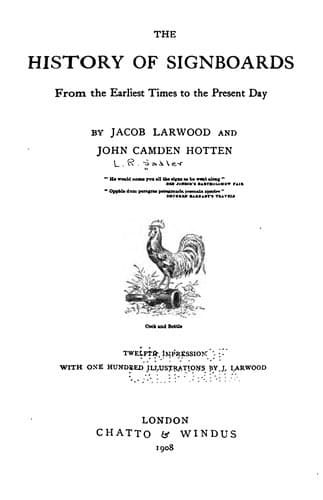
The History of Signboards, from the Earliest times to the Present DayHotten, John Camden
History
The History of Signboards, from the Earliest times to the Present Day
Hotten, John Camden
Inn signs -- England -- History; Signs and signboards -- History
Two portraits of Sommers are preserved at Hampton Court, one in a
picture after Holbein, representing Henry VII. with his queen,
Elizabeth, and Henry VIII. with his queen, Jane Seymour. Will is on one
side, his wife on the other. The other portrait is by Holbein,
three-quarter life size, where he is represented looking through a
closed window.[106] He also figures in Henry VIII.’s illuminated
Psalter,[107] in which King Henry’s features are given to David, and
those of Will Sommers to the fool who accompanies him.
Sommers was born at Eston Neston, Northamptonshire, where his father was
a shepherd. His popularity arose from his frankness, which is thus
eulogised by Ascham in his “Toxophilus:”--“They be not much unlike in
this to Wyll Sommers, the kingis foole, which smiteth him that standeth
alwayes before his face, be he never so worshipful a man, and never
greatlye lokes for him which lurkes behinde another man’s backe that
hurte him indeede.”
We next come to _Broughton_, the champion pugilist of England in the
reign of George II. He kept a public-house in the Haymarket, opposite
the present theatre; his sign was a portrait of himself, without a wig,
in the costume of a bruiser. Underneath was the following line, from
Æneid, v. 484:--
“HIC VICTOR CÆSTUS, ARTEMQUE REPONO.”
Numerous public-houses already retail their good things under the
auspices of the great TOM SAYERS. One in Pimlico, Brighton, deserves
especial mention, as it is reported to be the identical house in which
the mighty champion made his entry on the stage of this world, for the
noble purpose of dealing and receiving the blows of fistic fortune. But,
as in the case of Homer’s birthplace, the honour is contested; almost
every house in Pimlico lays claim to his nativity, and unless the great
man writes his life and settles this mooted point, it is likely to give
serious trouble to future historiographers.
Another athlete, TOPHAM, “the strong man,” had also his quantum of
signboards. “The public interest which his extraordinary exhibitions of
strength had always excited did not die with him. His feats were
delineated on many signs which were remaining up to 1800. One in
particular, over a public-house near the Maypole, in East Smithfield,
represented his first great feat of pulling against two dray
horses.”[108]
Public-domain text, read in full here on John Shaqi.
Reviews
Reviews
No reviews yet
Be the first to share your thoughts on this work.
Elsewhere in the archive
Join the Discussion
Join the discussion
Sign in to leave a comment or review.
Sign InorCreate an account