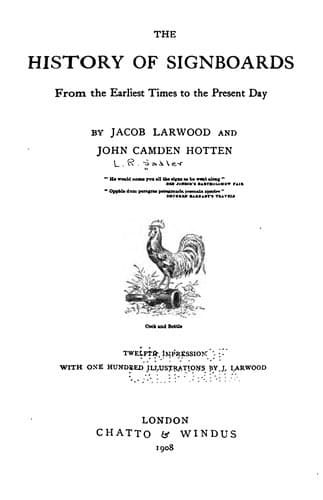
The History of Signboards, from the Earliest times to the Present DayHotten, John Camden
History
The History of Signboards, from the Earliest times to the Present Day
Hotten, John Camden
Inn signs -- England -- History; Signs and signboards -- History
“This is my friend Abel, an honest fellow,
He lets me have good tobacco, and he does not
Sophisticate it with sack lees or oil,
Nor washes it with muscadel and grains,
Nor buries it in gravel underground,
Wrapp’d up in greasy leather or p---- clouts,
But keeps it in fine lily pots, that open’d
Smell like conserve of roses, or French beans.
He has his maple block, his silver tongs,
Winchester pipes, and fire of juniper.
A neat, spruce, honest fellow, and no goldsmith.”
This worthy was, in the end of the last century, the sign of Peter
Cockburn, a tobacconist in Fenchurch Street, formerly shopman at the SIR
ROGER DE COVERLEY, as he informs the public on his tobacco paper.[105]
According to the custom of the times, and one which has yet lingered in
old-fashioned neighbourhoods, this wrapper is adorned with some curious
rhymes:--
“At DRUGGER’S HEAD, without a puff,
You’ll ever find the best of snuff,
Believe me, I’m not joking;
Tobacco, too, of every kind,
The very best you’ll always find,
For chewing or for smoaking.
Tho’ Abel, when the Humour’s in,
At Drury Lane to make you grin,
May sometimes take his station;
At number Hundred-Forty-Six,
In Fenchurch Street he now does fix
His present Habitation.
His best respects he therefore sends,
And thus acquaints his generous Friends,
From Limehouse up to Holborn,
That his rare snuffs are sold by none,
Except in Fenchurch Street alone,
And there by Peter Cockburn.”
FALSTAFF, whom we have already mentioned when speaking of Shakespeare,
and PAUL PRY, are both very common. The last is even of more frequent
occurrence than “honest Jack” himself.
Lower down in the scale of celebrities and public characters, we find
the court-jester of Henry VIII., OLD WILL SOMERS, the sign of a
public-house in Crispin Street, Spittalfields, at the present day. He
also occurs on a token issued from Old Fish Street, in which he is
represented very much the same as in his portrait by Holbein, viz.,
wearing a long gown, with hat on his head, and blowing a horn. Under an
engraving of this picture are the following lines:--
“What though thou think’st me clad in strange attire,
Knowe I am suted to my own deseire;
And yet the characters described upon mee
May shew thee that a king bestowed them upon mee.
This horn I have betokens Sommers’ game,
Which sportive tyme will bid thee reade my name,
All with my nature well agreeing to
As both the name, and tyme, and habit doe.”
Formerly there used to be in the town a wooden figure of Will with rams’
horns and a pair of large spectacles; and the story was told that he
never would believe that his wife had presented him with the “bull’s
feather” until he had seen it through his spectacles.
Public-domain text, read in full here on John Shaqi.
Reviews
Reviews
No reviews yet
Be the first to share your thoughts on this work.
Elsewhere in the archive
Join the Discussion
Join the discussion
Sign in to leave a comment or review.
Sign InorCreate an account