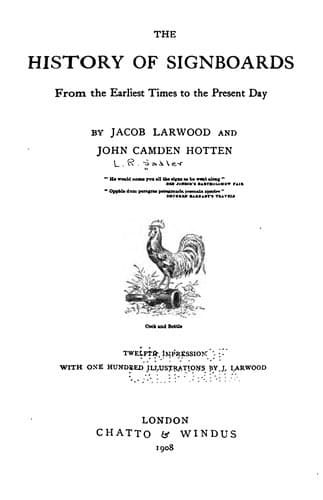
The History of Signboards, from the Earliest times to the Present DayHotten, John Camden
History
The History of Signboards, from the Earliest times to the Present Day
Hotten, John Camden
Inn signs -- England -- History; Signs and signboards -- History
Thomas Hobson, (Hobson’s Choice,) the benevolent old carrier, is the
sign of two public-houses in Cambridge,--the one called OLD HOBSON, the
other HOBSON’S HOUSE. His own inn in London was the BULL INN in
Bishopsgate Street, where he was represented in fresco, having a £100
bag under his arm, with the words, “The fruitful mother of an hundred
more.” There is an engraving of him by John Payne, his contemporary,
which also represents him holding a bag of money. Under it are these
lines:--
“Laugh not to see so plaine a man in print;
The shadow’s homely, yet there’s something in’t.
Witness the Bagg he wears, (though seeming poore,)
The fertile Mother of a thousand more.
He was a thriving man, through lawful gain,
And wealthy grew by warrantable faime.
Men laugh at them that spend, not them that gather,
Like thriving sonnes of such a thrifty father.”
The print also informs us that he died at the age of eighty-six, in the
year 1630. Milton, who wrote two epitaphs upon him, says, that “he
sickened in the time of his vacancy, being forbid to go to London by
reason of the plague.”
Among this class of minor celebrities we may also place those who put up
their own head for signs. Taylor, the water poet, (see Mourning Crown,
pp. 49,) was one of the first. Next to him followed PASQUA ROSEE;
according to his handbill, “the first who made and publicly sold
coffee-drink in England.” His establishment was “in St Michael’s Alley,
in Cornhill, at the sign of his own head.” This handbill largely enters
into the virtues of the “coffee-drink,” gives the natural history of the
plant, prescribes how to make the drink, and advises that “it is to be
drunk, fasting an hour before, and not eating an hour after, and to be
taken as hot as possibly can be endured; the which will never fetch the
skin off the mouth, or raise any blisters by reason of that heat.” The
next enters upon a glowing description of all the evils cured by that
drink, as fumes, headaches, defluxions of rhumes, dropsy, gout, scurvy,
king’s-evil, spleen, hypochondriac, winds, stone, &c. This coffee-house
was opened in 1652.
LEBECK’S HEAD was another instance of the owner setting up his own head
as a sign; and though his name has not filled the trumpet of fame, yet
had he many times bravely stood the fire, and filled the mouths of his
contemporaries, for he kept an ordinary (about 1690) at the north-west
corner of Half-moon Passage, (since called Bradford Street.) The sign
seems to have found imitators at the time, and is even yet kept up by
tradition. There is Lebeck’s Head in Shadwell, High Street; a Lebeck’s
Inn and Lebeck’s Tavern in Bristol; and a LEBECK AND CHAFF-CUTTER at a
village in Gloucestershire.
Public-domain text, read in full here on John Shaqi.
Reviews
Reviews
No reviews yet
Be the first to share your thoughts on this work.
Elsewhere in the archive
Join the Discussion
Join the discussion
Sign in to leave a comment or review.
Sign InorCreate an account