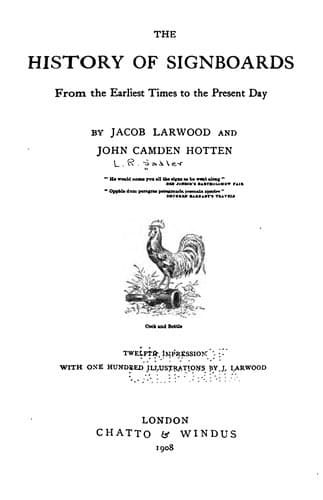
The History of Signboards, from the Earliest times to the Present DayHotten, John Camden
History
The History of Signboards, from the Earliest times to the Present Day
Hotten, John Camden
Inn signs -- England -- History; Signs and signboards -- History
A still more famous house was the PONTACK’S HEAD, formerly called the
WHITE BEAR, in Christ Church Passage, (leading from Newgate Street to
Christ Church.) This tavern having been destroyed by fire, Pontack, the
son of a president of the parliament of Bordeaux, opened a new
establishment on its site, and assuming his father’s portrait as its
sign, called it the Pontack’s Head. It was the first fashionable
eating-house in London, was opened soon after the Restoration, and
continued in favour until about the year 1780, when it was pulled down
to make room for the building of the vestry hall of Christ Church. De
Foe describes it as “a constant ordinary for all comers at very
reasonable prices, where you may bespeak a dinner from four or five
shillings a head to a guinea, or what sum you please.”[111] In the
beginning of the eighteenth century the dinners had become proverbially
extravagant:--
“Now at Pontack’s we’ll take a bit,
Shall quicken Nature’s appetite.
Here, shew a room! what have you got?
The waiter (cries) What have we not?
All that the season can afford,
Fresh, fat, and fine, upon my word
A Guinea ordinary, sir.”
This Guinea ordinary was:--
“---- every way compleat,
Adorn’d and beautifully dress’d.
But what it was could not be guess’d.”
The waiter, however, gives the _menu_, which contains--Bird’s nest soup
from China; a ragout of fatted snails; bantam pig, but one day old,
stuffed with hard row and ambergris; French peas stewed in gravy, with
cheese and garlick; an incomparable tart of frogs and forced meat; cod,
with shrimp sauce; chickens _en surprise_, (they had not been two hours
from the shell,) and similar dainties.[112] Pontack contributed much
towards bringing the French wines in fashion, being proprietor of some
of the Bordeaux vineyards which bore his name.
About the same time another tavern flourished, with its master’s head
for sign; this was CAVEAC’S,[113] celebrated for wine; of him Amhurst
sang:--
“Now sumptuously at Caveac’s dine,
And drink the very best of wine.”
Though it cannot be said that DON SALTERO put up his portrait for a
sign, yet his coffee-house was named after him, and is still extant
under the same denomination in Cheyne Walk, Chelsea. This house was
opened in 1695 by a certain Salter, who had been servant to Sir Hans
Sloane, and had accompanied him on his travels. Chelsea at that time was
a village, full of the suburban residences of the aristocracy, and the
pleasant situation of Salter’s house soon made it the resort of merry
companions, on their way to or from friends’ villas, or Vauxhall, Jenny
Whin’s, and other places of public resort in the neighbourhood.
Vice-Admiral Mundy, on his return from the coast of Spain, amused with
the pedantic dignity of Salter, christened him Don Saltero, and under
that name the house has continued till this day.
Public-domain text, read in full here on John Shaqi.
Reviews
Reviews
No reviews yet
Be the first to share your thoughts on this work.
Elsewhere in the archive
Join the Discussion
Join the discussion
Sign in to leave a comment or review.
Sign InorCreate an account