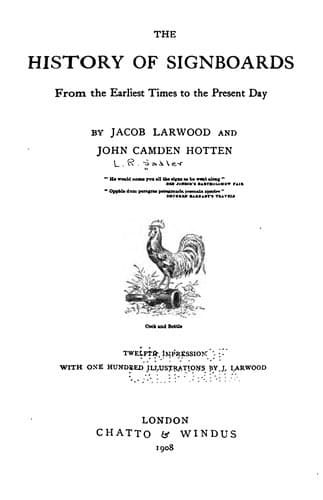
The History of Signboards, from the Earliest times to the Present DayHotten, John Camden
History
The History of Signboards, from the Earliest times to the Present Day
Hotten, John Camden
Inn signs -- England -- History; Signs and signboards -- History
Both these houses were named after “the Good Lord Cobham,”--Sir John
Oldcastle, who married the heiress of the Cobham family--the first
author, as well as the first martyr of noble family in England. Being
one of the Lollards, he was accused of rebellion, hanged in chains, and
burned alive at St Giles in the Fields, in December 1417. Lord Cobham’s
estates were close to the site of these two public-houses, which were
supposed to comprise a part of the ancient mansion of that nobleman.
The SIR PAUL PINDAR public-house, in Bishopsgate Street Without, is all
that remains of the splendid mansion of the rich merchant of that name,
who had here a beautiful park, well stocked with game. The house
continues almost in its original state, in the Cinque Cento style of
ornament; the best part of it is the façade. In “Londiniana,” ii. p.
137, is an engraving of a lodge, standing in Half-Moon Alley, ornamented
with figures, which tradition says was the keeper’s lodge of Sir Paul
Pindar’s Park. Mulberry trees, and other park-like vestiges, were still
within memory in 1829. In Pennant’s time it was already a public-house,
having for a sign, “a head, called that of the original owner.” Sir Paul
was a contemporary of Gresham, the founder of the Exchange. He travelled
much, and by that means acquired many languages, which, at that time,
was a sure way to advancement. James I. sent him as ambassador to the
Sultan, from whom he obtained valuable concessions for the English trade
throughout the Turkish dominions. After his return, he was appointed
farmer of the customs, and frequently advanced money to King James, and
afterwards to Charles I. In 1639 he was esteemed worth £236,000,
exclusive of bad debts. He expended £19,000 in repairing St Paul’s
Cathedral, and contributed large sums to various charities, yet, strange
to say, died insolvent, Aug. 22, 1650, the year after his royal master
had been beheaded. His executor, William Toomes, was so shocked at the
hopeless state of Sir Paul’s affairs, that he committed suicide, and was
buried with all the degrading ceremonies of a _felo-de-se_.
Public-domain text, read in full here on John Shaqi.
Reviews
Reviews
No reviews yet
Be the first to share your thoughts on this work.
Elsewhere in the archive
Join the Discussion
Join the discussion
Sign in to leave a comment or review.
Sign InorCreate an account