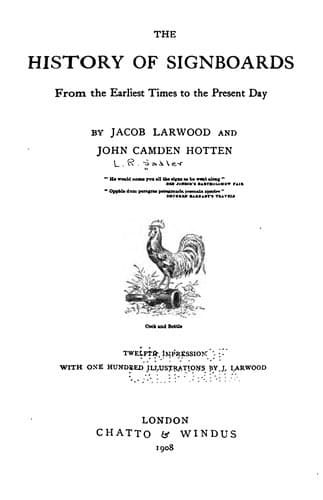
The History of Signboards, from the Earliest times to the Present DayHotten, John Camden
History
The History of Signboards, from the Earliest times to the Present Day
Hotten, John Camden
Inn signs -- England -- History; Signs and signboards -- History
The WELCH HEAD was the sign of a low public-house in Dyot Street, St
Giles. In the last century there was a mendicants’ club held here, the
origin of which dated as far back as 1660, at which time they used to
hold their meetings at the THREE CROWNS in the Poultry. Saunders Welch
was one of the justices of the peace for Westminster, and kept a regular
office for the police of that district, in which he succeeded Fielding.
He died Oct. 31, 1784, and lies buried in the church of St George’s,
Bloomsbury. He was a very popular magistrate: a story is told that in
1766 he went unattended into Cranbourne Alley, to quell the riotous
meetings of the journeymen shoemakers there, who had struck for an
advance of wages. One of the crowd soon recognised him, when they at
once mounted him on a beer barrel, and patiently listened to all that he
had to say. He quieted the rioters, and prevailed upon the master
shoemakers to grant an additional allowance to the workmen. This little
incident, joined to his well-known benevolence, and skill in capturing
malefactors, gave him that popularity which rewards by a signboard fame.
The BEDFORD HEAD, Covent Garden, represented the head of one of the
Dukes of Bedford, ground landlords of that district. Pope twice alludes
to this tavern, as a place where to obtain a delicate dinner. This house
Mr Cunningham[120] suspects to have occupied the north-east corner of
the Piazza, and there it appears in a view of old Covent Garden, about
1780, preserved in the “Crowle Pennant,” (vii. p. 25.) There was another
Bedford Head in Southampton Street, which was kept by Wildman, the
brother-in-law of Horne Tooke. A Liberal club used to meet at this
house, of which Wilkes was a member, for several years. There is still a
Bedford Head in Maiden Lane, hard by, at which the Reunion Literary Club
is held.
Under the historical signs may be ranged a class of more modern signs,
referring to local celebrities,--“mighty hunters before the Lord”
probably--such as CAPTAIN HARMER, White Horse Plain, Yarmouth; CAPTAIN
ROSS ON CLINKER, at Natland, a village in Westmoreland; CAPTAIN DIGBY
(the name of a vessel wrecked), at St Peter’s, Margate; COLONEL
LINSKILL, Charlotte Street, North Shields, &c.
Public-domain text, read in full here on John Shaqi.
Reviews
Reviews
No reviews yet
Be the first to share your thoughts on this work.
Elsewhere in the archive
Join the Discussion
Join the discussion
Sign in to leave a comment or review.
Sign InorCreate an account