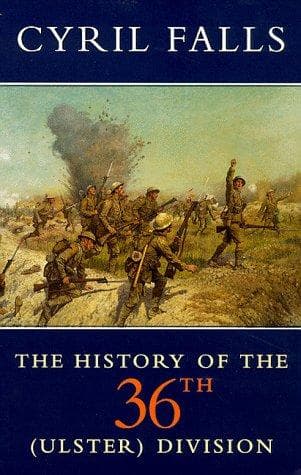
The History of the 36th (Ulster) DivisionFalls, Cyril
History
The History of the 36th (Ulster) Division
Falls, Cyril
Great Britain. Army. Division, 36th; World War, 1914-1918 -- Regimental histories -- Great Britain
Of the lessons the most obvious was that the barrage must be slower
and of greater depth. General Nugent, in notes written after the
battle as a comment upon captured orders of the Fourth German Army,
made some interesting suggestions in this regard. He stated in
the first case that the Germans could now no longer shell the area
over which our troops were advancing, since their own troops were
distributed in depth upon it. However much damage their barrage
did to our supports, it did little or none to the leading troops.
It was, however, more important to facilitate the advance of the
latter than to protect the rear area during an attack. If both could
not be accomplished, the artillery covering the front of assault
should be strengthened at the expense of counter-battery groups.
The creeping barrage, he suggested, might be slightly reduced to
one 18-pounder per twenty-five yards, and augmented by a sweeping
barrage, concentrated to cover about ten yards a gun, each group
sweeping right and left along the front allotted to it, with a higher
burst and greater searching effect upon shell-holes. The pace of the
creeping barrage must be reduced, and there must be more frequent
pauses. During these the sweeping barrage and a 60-pounder barrage
in front of it might sweep and search. He also made some remarks
upon the possibility of control of the barrage by the infantry, the
advantages of which are too obvious to merit discussion, and the
difficulties of which are equally apparent.
But the most interesting of General Nugent's suggestions were with
regard to the formations of the infantry. "With the adoption," he
wrote, "of a new form of German defensive tactics, consisting of
small parties dotted about a wide area, the disadvantages of long
lines of attack are that lines have small manœuvring capacity and
lack depth. It is for consideration whether mobile company columns
echeloned in depth on a narrow front, each a self-contained tactical
unit with a machine-gun and trench mortar, each operating within
an allotted zone, would not be a more suitable tactical formation
than the present system, which breaks up under machine-gun fire and
in badly shelled ground into a number of isolated groups without
cohesion or leaders."
It is to be noted that when, on September the 20th, the 9th
(Scottish) Division attacked at Frezenberg, the creeping barrage
advanced the first two hundred yards in eight minutes; then slowed to
a hundred yards in six minutes; halted on the first objective--four
to five hundred yards--no less than an hour, and went forward again
at the snail pace of a hundred yards in eight minutes. As regards the
infantry, the attack was carried out by lines of sections in file at
about twenty yards' interval. The system of "leap-frogging" was also
employed instead of special groups for "mopping up." This attack was
a complete success.[40]
[Illustration: Map III.
The Battle of Langemarck, 1917.]
FOOTNOTES:
Public-domain text, read in full here on John Shaqi.
Reviews
Reviews
No reviews yet
Be the first to share your thoughts on this work.
Elsewhere in the archive
Join the Discussion
Join the discussion
Sign in to leave a comment or review.
Sign InorCreate an account