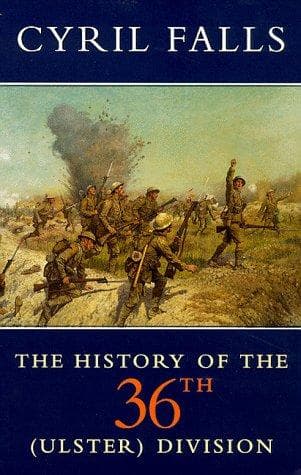
The History of the 36th (Ulster) DivisionFalls, Cyril
History
The History of the 36th (Ulster) Division
Falls, Cyril
Great Britain. Army. Division, 36th; World War, 1914-1918 -- Regimental histories -- Great Britain
[37] The official title of the campaign is "The Battles of Ypres,
1917"; that of the action of August 16th, in which the 36th Division
took part, "The Battle of Langemarck."
[38] The attack, after very heavy losses, was stopped by the orders
of the French Government. History will decide whether the stopping
was right or wrong. General Mangin, who commanded an Army in it,
has given his reasons for the belief that the attack should have
continued.
[39] See Map III.
[40] _History of the 9th (Scottish) Division._ By John Ewing.
CHAPTER VII
YPRES TO CAMBRAI: SEPTEMBER TO NOVEMBER 1917
Having once more left its Artillery and Pioneers in line, under the
orders of another division, the 36th Division, after four days'
rest about Winnizeele, moved south by train. The troops detrained
at Bapaume and Miraumont, ruins now, upon the church steeples of
which some of them had looked from the Mesnil Ridge a little over a
year before. With the Division moved the 1st Battalion Royal Irish
Fusiliers. This regular battalion had joined the Division in the
Salient before the Battle of Langemarck, but had not taken part in
that dolorous affair. Its arrival was highly significant. It was a
sign of the shortage of recruits from home. The 36th Division had not
been made up to strength between Messines and Langemarck, and was now
deplorably below it.
The country into which the troops stepped from their trains was of
a like they had not yet seen in all their active service. Behind
them lay the "shelled" area; that in which they now stood was the
"devastated" area. The former was featureless to an indescribable
degree. Marks of battle there were few, save for the stumps of trees.
All the countryside, its débris and its shell-holes, was covered with
a mass of very coarse grass. There were not even ruins, for buildings
had been blown flat and their rubble carted away to help maintain
the excellent main roads with which the area was now traversed. It
was hard to discover the sites even of villages. Most people who
used the Albert-Bapaume Road will remember a wooden cross whereon was
written: "This is the site of Le Sars Church." For that statement it
was necessary to take the writer's word. There was no other evidence.
The devastated area, on the other hand, had not been fought upon.
It represented the ground evacuated by the enemy in his retreat to
the Hindenburg Line. It had, however, been cleared of civilians and
scientifically demolished to make it as difficult and comfortless as
possible for our troops. All houses had been blown up by explosives,
bridges destroyed, fruit-trees cut down or gashed to death. Yet it
was far from being as dreadful or as ugly as the battle-field. The
ground was unbroken and covered with good grass or crop run to seed.
There were still woods and copses. It was depressing, yet far less
so than the Salient. It resembled primeval prairie, and the hutments
springing up here and there might have been the encampments of bold
pioneers.
Public-domain text, read in full here on John Shaqi.
Reviews
Reviews
No reviews yet
Be the first to share your thoughts on this work.
Elsewhere in the archive
Join the Discussion
Join the discussion
Sign in to leave a comment or review.
Sign InorCreate an account