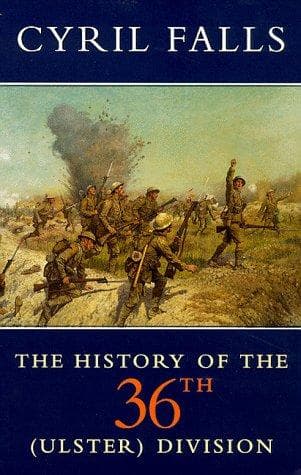
The History of the 36th (Ulster) DivisionFalls, Cyril
History
The History of the 36th (Ulster) Division
Falls, Cyril
Great Britain. Army. Division, 36th; World War, 1914-1918 -- Regimental histories -- Great Britain
From the village of Mœuvres the front system of the Hindenburg
Line[41] followed the western bank of the Canal du Nord for four
thousand yards, then crossed it, sweeping in a bold curve round
the village of Havrincourt and south of that of Ribécourt. It did
not, however, represent by any means the line held by the German
outposts, which were in general a thousand yards in advance of it,
and frequently in themselves stout and well-wired positions. Along
the banks of the Canal du Nord there were at intervals spoil heaps,
consisting of the chalk dug from its bed. Of these, two were of
great importance to the Division. The northern spoil heap was on the
front of the 109th Brigade, on the west bank of the Canal. Sixty
feet in height, it was strongly wired and had machine-guns mounted
on its flat top which swept our trenches. The southern spoil heap
was smaller, at the sharp bend west of Havrincourt, where the Canal
turned westward along the Grand Ravin. It was known as Yorkshire
Bank. There was a British trench on the top of it, but on its eastern
rim the Germans had established posts, rather unaccountably in view
of the aggressive character of the troops of the 9th Division. They,
too, seemed to feel that such a legacy to a relieving division was
unworthy their fame. On the night of August the 30th, before General
Nugent had taken over command of the front, a party of Argyll and
Sutherland Highlanders, advancing after the German part of the spoil
heap had been shelled with gas, drove out the enemy piquets and
established posts of their own. The 9th Division, therefore, was able
to leave an honourable legacy here after all, but a peculiarly lively
one. Next evening, after General Nugent had taken over the command
and established his headquarters in Little Wood, outside the village
of Ytres, the Germans hit back. After a bombardment of Yorkshire
Bank, they drove in our posts and re-established their own. At 4-15
a.m. next morning they were re-ejected. Next night they came again,
two parties bombing their way up simultaneously from either side.
At 1 a.m. on the 2nd the 12th Rifles retook the posts, with bomb
and Lewis gun. That evening at dusk an officer visiting the posts
saw Germans looking over the edge of the bank. They were rushed
immediately and driven out, leaving a wounded prisoner. Two nights
later they tried yet again, with typical German persistence. A shower
of bombs from the top of the spoil heap drove them off, and as they
were retreating a shell from a Stokes mortar was seen to drop in the
centre of a group. One other attempt was made, to meet with like
decisive failure. It was not an important affair, though it caused
the name of Yorkshire Bank to appear in the British _communiqué_
three days running. The 36th Division had had the better of the
exchanges, but did not unduly pride itself thereon, having a manifest
advantage in position.
Public-domain text, read in full here on John Shaqi.
Reviews
Reviews
No reviews yet
Be the first to share your thoughts on this work.
Elsewhere in the archive
Join the Discussion
Join the discussion
Sign in to leave a comment or review.
Sign InorCreate an account