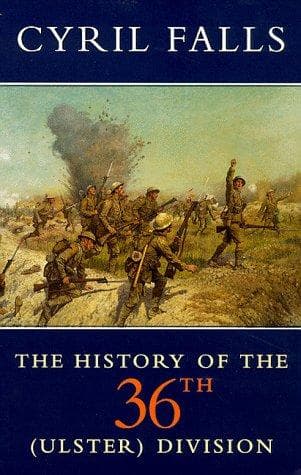
The History of the 36th (Ulster) DivisionFalls, Cyril
History
The History of the 36th (Ulster) Division
Falls, Cyril
Great Britain. Army. Division, 36th; World War, 1914-1918 -- Regimental histories -- Great Britain
For the rest, the area was rolling, well watered, and fairly thickly
wooded. In the big Havrincourt Wood, which had originally covered
some four square miles, the Germans had cut down much timber and
used it on the Hindenburg trenches, besides leaving a great many
trees lying on the ground. It still contained enough, however, to
afford excellent cover. The Hindenburg System was admirably sited,
and afforded to the enemy good observation of the area held by us,
particularly from the dark mass of Bourlon Wood, crowning the height
of the hundred-metre contour north of the Bapaume-Cambrai Road. In
such country as this, however, it was impossible for the Germans to
deny to us all the good ground. From the Hermies Ridge, from trees
in Havrincourt Wood, from the very front line on the Trescault
spur, the British had admirable views of their positions. Very
tantalizing they were to men who dwelt among ruins, for the villages
on the German side were intact, save for the nearest, which had been
slightly damaged by our shell-fire. Very distinct from one point, and
little more than eight miles off, were the steeples and roofs of the
beautiful city of Cambrai.
There was a striking contrast between the trenches in the Trescault
and Havrincourt sectors, and those in the northern or Hermies sector.
The former consisted of a whole series of lines, so many trenches
that they had to be occupied and defended at intervals only, by a
system of "localities," each manned in general by a platoon. These
trenches had, in fact, been prepared in the spring for assembly with
view to an offensive which did not eventuate. In the Hermies sector,
on the contrary, there were practically no defences at all, save a
shadowy front line and some trenches round the village. This northern
sector had been held by the 27th Brigade of the 9th Division,
commanded by the celebrated Brigadier-General F. A. Maxwell, V.C.,
who was killed in the Salient shortly after his Division had moved
north. He, apparently, was not a believer in trenches, and relied
on holding his position by counter-attack from the Hermies defences
and from behind the high ridge along which ran the Hermies-Demicourt
Road. The plan did not appeal to General Nugent or to General
Ricardo, commanding the 109th Brigade, and a heavy programme of
trench-digging and wiring in the Hermies sector was at once drawn up.
Public-domain text, read in full here on John Shaqi.
Reviews
Reviews
No reviews yet
Be the first to share your thoughts on this work.
Elsewhere in the archive
Join the Discussion
Join the discussion
Sign in to leave a comment or review.
Sign InorCreate an account