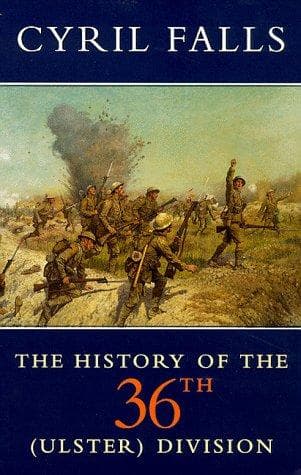
The History of the 36th (Ulster) DivisionFalls, Cyril
History
The History of the 36th (Ulster) Division
Falls, Cyril
Great Britain. Army. Division, 36th; World War, 1914-1918 -- Regimental histories -- Great Britain
Meanwhile, in the Salient, the Artillery and 16th Rifles endured a
bitter period. Indeed, it is to be doubted whether any Divisional
Artillery, since the second Battle of Ypres in 1915, had been
subjected to strain such as that which now fell to the lot of the
36th Division's gunners. They had gone into action on July the 14th,
in support of the 55th Division. They remained in action after the
36th Division had departed, and on August the 21st supported an
unsuccessful attack by the 61st Division on the same front. They were
not relieved till the night of the 23rd. And these six weeks had
represented battle conditions in their worst form, a huge expenditure
of ammunition, heavy and continuous hostile counter-battery, shelling
of wagon-lines, the scantiest of accommodation, mud and indescribable
wretchedness. A great proportion of the personnel had disappeared,
new officers were commanding sections and junior officers batteries,
when they detrained at the end of August at Bapaume. The lot of the
Pioneers was not quite so hard, but their period in the Salient was
longer. Two companies worked on the ruins of the infantry barracks
at Ypres, the remainder on screening the Menin Road, on a trench
tramway to Railway Wood, on the construction of strong points on
the Westhoek Ridge, and like tasks, till September the 30th, when
the battalion was entrained at Vlamertinghe and sent to rejoin the
Division.
The line now held by the Division was on the whole the pleasantest
it had ever known. This does not imply that the troops were allowed
to take life easily. On the contrary, the fighting arms displayed
considerable aggression, with important results. The German methods
of defence, with outposts far in front of the main Hindenburg System,
not always very strongly defended, and sometimes held at night only,
offered considerable opportunity for those little silent raids upon
isolated piquets which the Canadians had perfected, and knew by the
expressive term "winkling." The first affair was on a scale rather
bigger than this implies, parties of about sixty being engaged on
either side. The scene was Wigan Copse, north of Yorkshire Bank, and
the result the retirement of the Germans, leaving a wounded prisoner
in the hands of the 12th Rifles, who had an officer and four men
slightly wounded. That was on October the 6th. Three days later,
at dusk, the 10th Rifles cut the wire of a post on the edge of the
eastern arm of Havrincourt Wood, known as Fémy Wood, waited for the
garrison to arrive, captured its leader, a corporal, and killed the
remaining ten. On the 23rd, a party of the 11th Rifles, covering
work on our wire, made a neat capture of six men who approached
it, closing in on them from either flank, and taking them without
a shot fired. Another prisoner was captured by the 1st Royal Irish
Fusiliers, now in the 107th Brigade, when one of its saps north of
Trescault was unsuccessfully attacked by the enemy. Various other
Public-domain text, read in full here on John Shaqi.
Reviews
Reviews
No reviews yet
Be the first to share your thoughts on this work.
Elsewhere in the archive
Join the Discussion
Join the discussion
Sign in to leave a comment or review.
Sign InorCreate an account