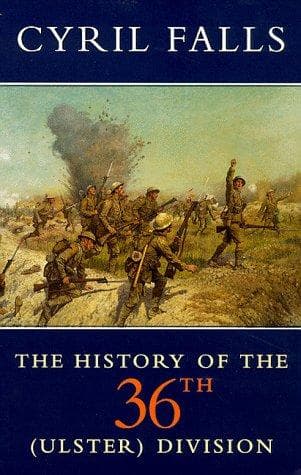
The History of the 36th (Ulster) DivisionFalls, Cyril
History
The History of the 36th (Ulster) Division
Falls, Cyril
Great Britain. Army. Division, 36th; World War, 1914-1918 -- Regimental histories -- Great Britain
of forty-five barrels a day. A soda-water factory was established on
the Canal bank at Manancourt. Soda-water, labelled "Boyne Water," a
fancy which appealed to the troops, was sold at a penny a bottle,
and various other aerated concoctions at twopence. The Divisional
Canteens, always of the greatest benefit to the troops, became then
of incalculable importance. Added to their usual "lines"--tobacco,
biscuits, chocolate, tinned foods, books, candles--were now sold in
great quantities fruit and vegetables, eggs, bread and cake, and,
when procurable, fresh fish and even oysters; while special orders
for anything required in Amiens by officers or men were taken, the
goods being procured by the following evening, and sold to the
buyer at cost price. The Division had long had a cinema, a concert
party--"The Merry Mauves"--and an excellent band. These passed up
and down the front, all units taking turns in the pleasures of their
performances. Football and boxing competitions reappeared. There
was one very exciting race meeting and horse show, with numerous
classes for transport turn-outs. For animals at least the area was a
paradise, there being unlimited grazing and great fields of clover.
Some agriculture was attempted, over a hundred acres being ploughed
and sown. A few headquarters purchased cows, and many units pigs and
chickens.
To those who cared to ponder such things, the wonders of the great,
creaking, rather clumsy machine, in which it took a thousand men
to form the tiniest cog, never ceased to appeal. The British
organization for war was assuredly by now amazingly thorough. Was
there required some new-fangled and complicated Lewis-gun-mounting
for trench warfare; a message and a tracing to some workshop behind
brought a hundred in a week. Copies innumerable of an enlarged
aeroplane photograph wanted in a hurry for a raid could be printed
off at Albert in twenty-four hours. The little press of the IV.
Corps, the Intelligence Branch of which officers of the 36th Division
will remember with gratitude, seemed to pour forth up-to-date maps.
If there was the slightest hitch about rations, it was the topic of
conversation for a week. The post-office was an unceasing marvel.
In Flanders, Divisional Headquarters had had their newspapers the
day they were published, and the rest of the troops next morning.
The letters for men in the saps reached them in two or at most three
days. A letter to Hermies would probably take longer now.
Public-domain text, read in full here on John Shaqi.
Reviews
Reviews
No reviews yet
Be the first to share your thoughts on this work.
Elsewhere in the archive
Join the Discussion
Join the discussion
Sign in to leave a comment or review.
Sign InorCreate an account