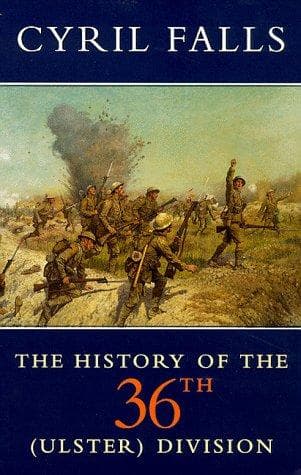
The History of the 36th (Ulster) DivisionFalls, Cyril
History
The History of the 36th (Ulster) Division
Falls, Cyril
Great Britain. Army. Division, 36th; World War, 1914-1918 -- Regimental histories -- Great Britain
But, there was no doubt about the matter, the organization was
expensive in man-power, and man-power at that moment was a problem
that engaged G.H.Q. almost as much as did the enemy. The writer
of this book can well remember being sent, in Flanders, when the
Division was very weak, to investigate the number of men a certain
battalion had in the trenches. The "paper strength" of that battalion
was just six hundred men. It had in the line, exclusive of its
headquarters, one hundred and seven men. He went through the state
with the adjutant. That revealed, indeed, a remarkably strong
battalion headquarters, and an undue number at the transport lines,
but no other leakages which the adjutant had power to stop. There
was a number of men at Divisional Headquarters, clerks, draughtsmen,
orderlies, a cook, five attached to the Signal Company; and about
three times as many at Brigade Headquarters. The rest followed varied
avocations. Five were on traffic control, a number attached to a
Tunnelling Company. There were clerks to town majors, camp wardens,
guardians of coal, straw, and ration dumps; cooks and servants at
the Rest Camp. There were about forty on leave, and twenty sick not
evacuated.
There were also twenty at various schools. Schools were a vital
necessity; but who at this period can doubt that they were
ludicrously overdone? Every formation had its schools--G.H.Q., the
Army, the Corps, the Division, the Brigade. There were infantry
schools, artillery schools, and trench-mortar schools; machine-gun
schools, Lewis-gun schools, bombing schools, gas schools; schools
which taught horse-mastership, shoe-making, brick-laying, carpentry,
sanitation, butchery, cooking. For a weak Division, schools became a
nightmare. Divisional commanders had to protest that they had either
to man their trenches inadequately, or refuse vacancies allotted.
And vacancies refused raised a vast to-do, because they threatened
the existence of the school, and the school naturally appealed to
the formation of which it was the _protégé_. Up to the Division
headquarters this did not so largely matter. The Division may have
been inconsiderate at times, but it did know precisely how its line
was held, how strong its posts, how far separated. But above the
Division the situation was not always so quickly grasped. The Corps
was an impersonal affair, encamped, sometimes for years, upon the
same front, changing its Divisions week by week. And when a Corps
headquarters, as happened before Cambrai, resting out of the line,
sent out appeals for students to attend _its_ schools, so that they
might not be idle, the most long-suffering were inclined to protest
and to feel that, after all, for the idle, there was a certain work
which might have been accomplished somewhat further forward. The
jests of most humorists are based upon exaggeration, but there is
just a kernel of truth in them, or they are not good jests. Of such
nature is the dictum of M.
Public-domain text, read in full here on John Shaqi.
Reviews
Reviews
No reviews yet
Be the first to share your thoughts on this work.
Elsewhere in the archive
Join the Discussion
Join the discussion
Sign in to leave a comment or review.
Sign InorCreate an account