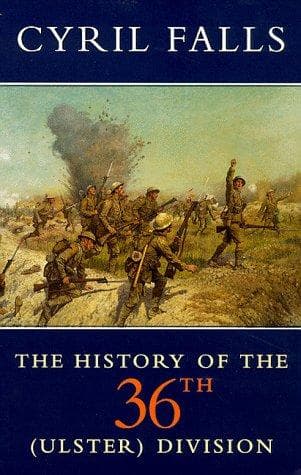
The History of the 36th (Ulster) DivisionFalls, Cyril
History
The History of the 36th (Ulster) Division
Falls, Cyril
Great Britain. Army. Division, 36th; World War, 1914-1918 -- Regimental histories -- Great Britain
The attack carried out by the 109th Brigade has been officially
described as a "bombing action," and such, doubtless, to a great
extent it was. But there was no fear more constantly present with
General Nugent and General Ricardo than that of its developing into
the conventional bombing action, which progressed at snail's pace at
best, at worst reached an early deadlock, and always required bombs
by the dozen for every yard of ground gained. In this case four
thousand yards, covered by two or three parallel lines of trenches,
with numerous communication trenches at right angles to the attack,
had to be taken. And speed was essential; for, much as the attack
depended upon the advance east of the Canal, that in its turn could
have been taken in flank by machine-gunners on the west had not the
109th Brigade kept pace with it. And so the order was--no bombing
till other methods failed. At the head of the platoon columns to
move up the trenches was to be not a bomber, but a Lewis gunner. A
Lewis gun could be used by a man of large physique--and of these
the Ulster Division still possessed plenty, if not such numbers as
a year back--with a sling over the left shoulder, the gun resting
above the right hip. It was heavy and clumsy, but its tremendous
moral effect in such broad trenches as those of the Hindenburg System
can readily be imagined. It was to be the spear-head of the attack
along each line of trenches. General Ricardo had learnt the idea from
the Canadians, who had employed it at Vimy. Moreover, when it was
found possible, riflemen were to move on top, outside the trench.
The question of artillery support was not easy, since no preliminary
registration, here, or on any other part of the front of attack, was
possible. Colonel Simpson, who took up his position with General
Ricardo at a command post in the sunken Demicourt-Havrincourt Road,
just short of the British front line, planned and controlled the
artillery support in most brilliant fashion, well worthy the fame
he was winning as one of the most scientific and least conventional
junior artillery commanders in the British Army. It must not be
supposed that the part played here, or on the whole front, by
artillery was negligible, nor that the barrage was inconsiderable. On
the contrary, the artillery support for the main attack was of vast
weight. In Havrincourt Wood, along the rides, guns stood almost wheel
to wheel. But these guns had not registered. Consequently the barrage
might be expected to be somewhat ragged, and was to keep considerably
further in front of the tanks and infantry than would otherwise have
been the case. Still, a barrage does not cut wire. It was the tanks
which were to accomplish this. Had they failed, the whole scheme
would have collapsed. During the night of November the 19th, the
whole line of tanks on the front of the III. and IV. Corps moved to
a general distance of a thousand yards from the German outpost line.
Public-domain text, read in full here on John Shaqi.
Reviews
Reviews
No reviews yet
Be the first to share your thoughts on this work.
Elsewhere in the archive
Join the Discussion
Join the discussion
Sign in to leave a comment or review.
Sign InorCreate an account