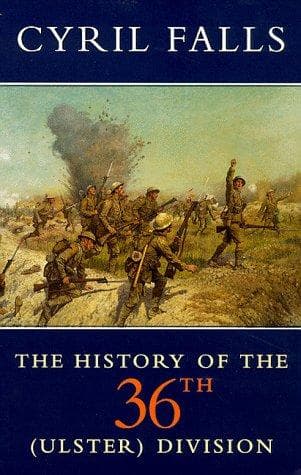
The History of the 36th (Ulster) DivisionFalls, Cyril
History
The History of the 36th (Ulster) Division
Falls, Cyril
Great Britain. Army. Division, 36th; World War, 1914-1918 -- Regimental histories -- Great Britain
At 1-30 the 107th and 108th Brigades moved forward, the former to
the northern slope of the Grand Ravin about Square Copse, the latter
to Yorkshire Bank and the old British trenches south of it. It had
now begun to rain heavily, and these troops, particularly those of
the 107th Brigade, which were without any shelter, were drenched to
the skin. At 8 o'clock the 107th Brigade was ordered across into
Havrincourt and the trenches and dug-outs about it. The men were
not finally settled with an opportunity for rest till 3 a.m. the
following morning. The 10th Inniskillings of the 109th Brigade,
which had carried out the first stages of its attack, was moved
across the Canal to Kangaroo Alley, south of and parallel with the
Bapaume-Cambrai Road. Patrols pushed forward on the west side by the
11th Inniskillings got within five hundred yards of the southern
outskirts of Mœuvres, where they encountered resistance enough to
compel them to withdraw. There is no reason, however, to suppose
that Mœuvres was at this time strongly held, or that a determined
attack would have failed to take it. The progress east of the Canal
did not appear to warrant such an attack. The Engineers meanwhile
had progressed excellently with their bridge-making. By 4 p.m. their
bridge for infantry and pack transport, about a thousand yards north
of the Hermies-Havrincourt railway line, was available. Half an hour
later a still more important task had been accomplished; the existing
causeway on the Demicourt-Flesquières Road having been repaired to
enable field-guns and wagons to cross. The 36th Division would have
been glad to have had at this stage its Pioneer Battalion to work
upon its own roads, now being churned up by heavy traffic, but it
was employed upon a similar task between Havrincourt and Ribécourt.
The Signal Service, admirably organized by Major Vigers, who on this
occasion excelled, if that were possible, his successes at Messines,
had opened up telephone communication, utilising the Canal bed to lay
its wires. So good was this that it was a matter of no difficulty to
speak from Divisional Headquarters, which still remained at Ytres, to
Lock 6, just south of the Bapaume-Cambrai Road.
When dusk came down to bring operations to a halt, the situation
was as follows. The 36th Division held a general line five hundred
yards north of the Bapaume-Cambrai Road, in touch with the 56th on
its left. East of the Canal the 62nd Division held the trench north
of the road and the factory. Thence their line curved down just west
of Anneux, with a long flank running east of Graincourt to the west
of Flesquières. The line of the III. Corps ran well to the north of
Noyelles. This left, as will be seen from the line roughly marked
on the map, an extraordinary little German salient, in the midst of
which there were still apparently German guns in action in Orival
Wood.
Public-domain text, read in full here on John Shaqi.
Reviews
Reviews
No reviews yet
Be the first to share your thoughts on this work.
Elsewhere in the archive
Join the Discussion
Join the discussion
Sign in to leave a comment or review.
Sign InorCreate an account