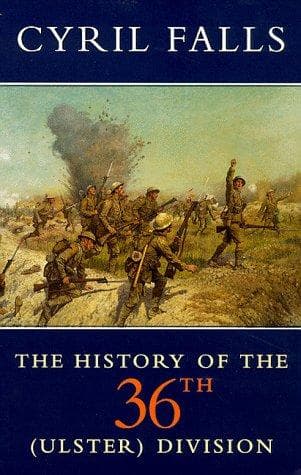
The History of the 36th (Ulster) DivisionFalls, Cyril
History
The History of the 36th (Ulster) Division
Falls, Cyril
Great Britain. Army. Division, 36th; World War, 1914-1918 -- Regimental histories -- Great Britain
The close of this rather unsatisfactory day may fittingly mark
the end of a chapter. After wonderful initial success the action
had not continued as planned. Little has been said of the extreme
right flank because space does not permit. Nor does it in any way
concern the 36th Division. But here also, though Masnières, across
the Canal de l'Escaut, had been taken, the great cavalry "drive"
had been a failure. Henceforth the battle was to be fought in other
circumstances. Fresh German troops were up now, and resistance all
along the line was fierce. Every yard of ground had to be won by hard
fighting. The idea of exploitation to the Sensée River must have
faded from the mind of the Commander of the Third Army. Indeed, he
permitted a Division intended for that purpose, the 40th, to relieve
the 62nd, now very weary. But much had been won. It was of the
highest importance now to take the Bourlon Ridge. While it remained
in German hands all our positions were overlooked, and could have
been made in time almost untenable. In our hands, on the contrary,
it would have been a veritable thorn in the side of the Germans, and
would soon have compelled an important retirement to the north, if
neither so swift nor so great as that which would have been involved
by our reaching Oisy-le-Verger.
A new phase was opening, of powerful forces on either side battling
fiercely for position. And the crown of battle, looming up above the
combatants, was the great circular mass of the Bois de Bourlon.
FOOTNOTES:
[43] Aux moments sombres de la guerre, nous nous sommes souvent
demandés: "Si Napoléon sortait de son tombeau aux Invalides, que nous
dirait-il, que ferait-il de nos armées actuelles?"
Il nous aurait dit: "Vous avez des millions d'hommes; je ne les
ai jamais eus. Vous avez les chemins-de-fer, le télégraphe, la
télégraphie sans fil, les avions, l'artillerie à longue portée, les
gazs asphyxiants; je n'avais rien de tout cela. Et vous n'en tirez
point parti? Vous allez voir!"
Et, dans un mois ou deux, il aurait tout renversé, réorganisé, mis en
œuvre de quelque façon nouvelle, et culbuté l'ennemi désorienté.
MARSHAL FOCH: _The Times_ (Napoleon Supplement),
Thursday, May 5th, 1921.
[44] Map IV.
[45] 62nd Division.
CHAPTER IX
CAMBRAI AND AFTER (II): NOVEMBER 23RD TO DECEMBER 31ST, 1917
Public-domain text, read in full here on John Shaqi.
Reviews
Reviews
No reviews yet
Be the first to share your thoughts on this work.
Elsewhere in the archive
Join the Discussion
Join the discussion
Sign in to leave a comment or review.
Sign InorCreate an account