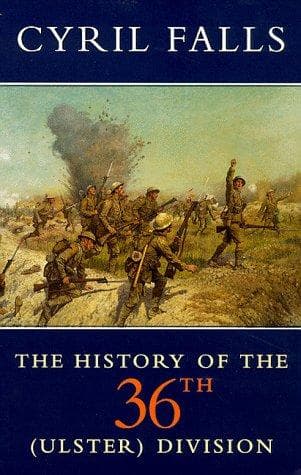
The History of the 36th (Ulster) DivisionFalls, Cyril
History
The History of the 36th (Ulster) Division
Falls, Cyril
Great Britain. Army. Division, 36th; World War, 1914-1918 -- Regimental histories -- Great Britain
The 25th was an eventless day for the troops of the 36th Division,
but for heavy shelling, particularly of its batteries. On the right
the Germans again attacked Bourlon, as it was inevitable they should,
while they had a battalion to go forward or artillery to cover its
advance. After hard fighting they retook it, but could not penetrate
the wood, which was in fact now almost impassable, owing to the haze
of the gas with which it had been drenched among the trees. The 40th
Division had suffered heavy casualties, and was relieved at night by
the 62nd. On the following night the 36th Division was to have taken
over a wider front, extending its line to within a thousand yards
of the western edge of Bourlon Wood. The 107th Brigade had suffered
appreciable casualties and its troops were jaded, so the 108th
Brigade was to relieve it. At the last moment, however, these orders
were cancelled. The Commander of the IV. Corps decided to relieve the
36th Division by the 2nd, which had been put at his disposal, and
ordered that the relief should take place that night. The Artillery,
Engineers, and Pioneers were to remain at the disposal of the 2nd
Division. The machine-guns were to be relieved twenty-four hours
later.
The night of November the 26th will remain an unpleasant memory
to the survivors of the troops who were then relieved. The snow
had come now, and swept almost horizontally before a wind that
rose at times to tempestuous force. The relief took a very long
time. When it was over, and the men staggered through the blizzard
to the very indifferent havens that were to be their lodgings
for the night--Beaumetz for the 108th Brigade, Doignies for the
109th, Hermies and the trenches about it for the 107th--they found
this shelter, such as it was, packed with odd units. Doignies, in
particular, had scarce a corner, being full of details of another
Division. The besetting sin of the British Army, the accumulation
of what might almost be described as camp followers, was on such
occasions as these a curse. A good many men spent what was left of
the night in the open, in the snow.
The following day the Division, less Artillery, Engineers, and
Pioneers, moved to the area Barastre-Rocquigny-Beaulencourt, where
the men had at least some comfort and the chance to sleep. A day
was spent here in the usual tasks of cleaning, refitting, and
reorganization.
Public-domain text, read in full here on John Shaqi.
Reviews
Reviews
No reviews yet
Be the first to share your thoughts on this work.
Elsewhere in the archive
Join the Discussion
Join the discussion
Sign in to leave a comment or review.
Sign InorCreate an account