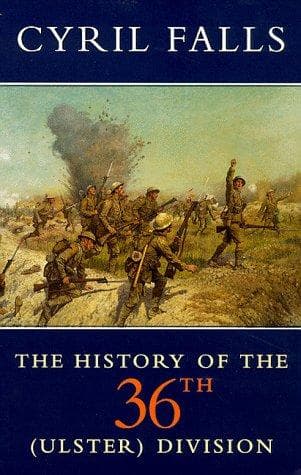
The History of the 36th (Ulster) DivisionFalls, Cyril
History
The History of the 36th (Ulster) Division
Falls, Cyril
Great Britain. Army. Division, 36th; World War, 1914-1918 -- Regimental histories -- Great Britain
The Division, to which the 121st Field Company had now been returned,
was transferred on November the 29th from the IV. to the XVII.
Corps, which was holding the line east of Arras. It was to move to
the area round Fosseux by tactical trains from Ytres and Bapaume,
the transport moving by road, staging on the night of the 29th at
Gomiecourt, Achiet-le-Petit, and Courcelles-le-Comte, ruined villages
of the Somme area, in which some shelter for men and animals had been
constructed. An agreeable prospect was held out by Staff Officers of
the XVII. Corps of some weeks at least out of the line. How far it
was realized will shortly appear. For the explanation we must turn
once more to the line at Cambrai.
The IV. Corps made another attempt upon Bourlon, the morning after
the relief of the 36th Division. Aided by tanks the 62nd Division
captured half the village, but could not hold it against powerful
German counter-attacks. It clung still, however, to the eastern
houses and to the wood. Three battalions of the Guards' Division
penetrated Fontaine, but were unsupported and had to be withdrawn at
dusk. The resources of the Third Army permitted no further attack. On
the evening of the 29th the IV. Corps relieved the Guards' Division
by the 59th and the 62nd by the 47th. It had thus in line on the 30th
three comparatively fresh Divisions.
On the morning of the 30th was launched the great German
counter-offensive. It is called counter-offensive advisedly. It was,
in effect, the greatest attack made by German forces on the Western
Front since Verdun had died down, more than eighteen months before.
Counter-attacks on a large scale had been expected, and preparation
made to meet them, but this was something far more serious. It was
a deliberately prepared attempt, supported by a great weight of
artillery, to apply pincers north and south to the large salient
formed by our recent advance. Its effect was curious, since on the
south it was completely successful, while on the north it gained
scarce a yard.
Public-domain text, read in full here on John Shaqi.
Reviews
Reviews
No reviews yet
Be the first to share your thoughts on this work.
Elsewhere in the archive
Join the Discussion
Join the discussion
Sign in to leave a comment or review.
Sign InorCreate an account