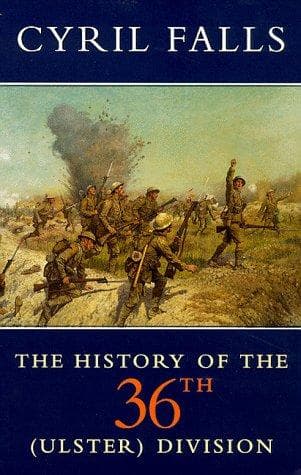
The History of the 36th (Ulster) DivisionFalls, Cyril
History
The History of the 36th (Ulster) Division
Falls, Cyril
Great Britain. Army. Division, 36th; World War, 1914-1918 -- Regimental histories -- Great Britain
Of the northern blow the weight fell mainly from Bourlon Wood
westward, upon the 47th, the 2nd, and 56th Divisions. The resistance
of these, one an "Old Army" Division, the others London Territorials,
stands high among the achievements of the British Army in the war.
Here and there a section of trench was lost, a portion of a line
slightly withdrawn, a position temporarily abandoned, but, broadly
speaking, the great assault, launched in eight or ten successive
waves, followed by columns in artillery formation, preceded by a
whirlwind bombardment of all calibres, with gas and smoke, was
a total failure. Repeated attacks throughout the day met a like
fate. And not since the early days of the war had our artillery and
machine-guns seen such targets. The fact that the IV. Corps Heavy
Artillery had not been moved into the German lines, but was about
Doignies and Demicourt, was now of incalculable value. It took the
advancing host in enfilade. The field artillery likewise did enormous
execution. The Left Group covering the 2nd Division consisted of the
153rd and 173rd Brigades, under the command of Colonel Simpson, who
was with the Infantry Brigadier in the old headquarters in "Scotch
Street." The 153rd Brigade alone fired ten thousand rounds that day.
Many large parties of the enemy were caught in the open by its fire.
Enemy batteries were seen following up the attack, unlimbering and
coming into action. Several sections of 18-pounders and 4.5 howitzers
of the 173rd Brigade were run up on to the crest of the Demicourt
Ridge, whence they annihilated these batteries with direct fire. Ere
nightfall a situation which had had critical moments was restored.
But, as all the world knows, no such rebuff met the southern arm
of the pincer. Here the Germans broke through the British lines;
Masnières, defended by a brigade of the 29th Division, held out, but
to the extreme south of the original advance the front collapsed.
La Vacquerie was retaken by the enemy. Further south he bit deeply
even into our old line, taking Villers-Guislain, Gonnelieu, and
Gouzeaucourt, all of which had been ours before November the 20th,
and the last-named of which had then been over two thousand yards
from our front line. The prisoners captured by the enemy ran into
many thousands, and the guns into hundreds. It was a woeful affair,
of which the main causes were the lack of an organized defence in
depth, and that of training in junior officers and men.
Public-domain text, read in full here on John Shaqi.
Reviews
Reviews
No reviews yet
Be the first to share your thoughts on this work.
Elsewhere in the archive
Join the Discussion
Join the discussion
Sign in to leave a comment or review.
Sign InorCreate an account