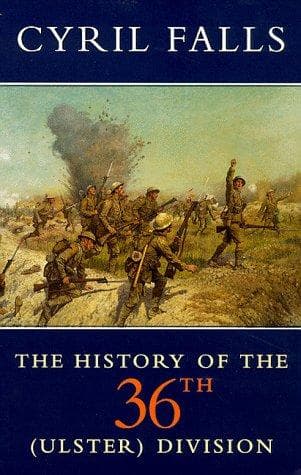
The History of the 36th (Ulster) DivisionFalls, Cyril
History
The History of the 36th (Ulster) Division
Falls, Cyril
Great Britain. Army. Division, 36th; World War, 1914-1918 -- Regimental histories -- Great Britain
On December the 4th the 107th and 109th Brigades moved up from
Lechelle and Bertincourt, halting in Havrincourt Wood for dinners
_en route_. The 107th Brigade was disposed in old British trenches
between Beaucamp and Villers-Plouich, the 109th in the old German
front line north of the former, where it was in reserve to the 6th
Division. The two Field Companies left behind, and the Pioneers,
rejoined the Division, moving to a camp near Dessart Wood.
Headquarters of the Division were established in an infantry camp at
Sorel-le-Grand. That night the 108th Brigade relieved the 88th in
the line, in the Couillet Valley. The next night the 109th Brigade
followed, taking over the important plateau known as Welsh Ridge from
the 182nd Brigade of the 61st Division.
On this night G.H.Q. carried out a grave but inevitable decision.
The success of the German attack on the southern face of the
Bourlon-Noyelles-Masnières Salient had made that salient so narrow
in proportion to its depth that its maintenance would be a constant
source of attrition. A considerable portion of the ground here,
including Bourlon Wood, Cantaing, Noyelles, Graincourt, and Marcoing,
was evacuated, all dug-outs within the area being systematically
destroyed. This withdrawal was to have an effect upon the relief to
be carried out by the 36th Division.
The new line, of which General Nugent assumed command on the relief
of the 182nd Brigade, was curious and somewhat indeterminate as to
exact position. It represented an acute salient, of which the nose
pointed due east. Behind this ran, from south-west to north-east,
the deep, densely-wooded Couillet Valley. At the south-west end was
the ruined village of Villers-Plouich, at the north-east the little
damaged village of Marcoing, captured by the British in the Cambrai
battle, but now again in German hands. On either side of the Couillet
Valley were the two ridges destined to become famous, Welsh Ridge
on the south-east, and Highland Ridge on the north-west. Across
these, at right angles to the Couillet Valley, ran the two Hindenburg
Systems, which on Welsh Ridge drew to within two hundred yards of
each other, forming a single system of defence. That fact proved how
highly the men who had sited those trenches rated the importance
of Welsh Ridge. To the British at this moment it was well-nigh as
valuable as it had been to the enemy.
Public-domain text, read in full here on John Shaqi.
Reviews
Reviews
No reviews yet
Be the first to share your thoughts on this work.
Elsewhere in the archive
Join the Discussion
Join the discussion
Sign in to leave a comment or review.
Sign InorCreate an account