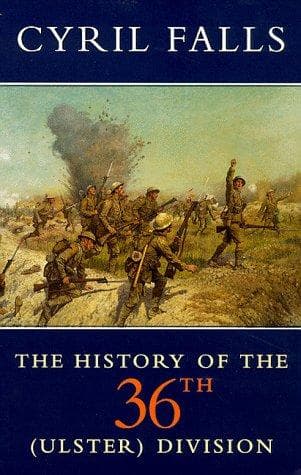
The History of the 36th (Ulster) DivisionFalls, Cyril
History
The History of the 36th (Ulster) Division
Falls, Cyril
Great Britain. Army. Division, 36th; World War, 1914-1918 -- Regimental histories -- Great Britain
It will be remembered that the evacuation of Marcoing had taken
place on the night of the 4th. There was still some uncertainty
as to the position of the British outpost line. There was more
before the relief was complete. The 9th Inniskillings of the 109th
Brigade sent its No. 3 Company in advance up on to the Welsh Ridge
in the afternoon. This company arrived in the midst of a tremendous
bombardment, amid which the bursts of captured English 18-pounder
high explosive were only too apparent to the experienced eye. It
was greeted by the unpleasant news that the Germans were bombing
up the Hindenburg Support Systems, had already made considerable
headway, and that the troops awaiting relief, demoralized by utter
weariness and exposure, and by the bombardment which had reduced
them to a handful, were at that moment retreating only too fast.
The company, as was natural in such a bombardment, was spread out
with very long intervals between the platoons. The leading platoon
was at once pushed along the front line. It had few bombs and no
artillery support, so had to rely upon rifle fire. But it stopped
the German advance. Three times the enemy pressed up the trench,
and thrice was driven back. Moreover, on the report that the enemy
was advancing also up the second line, two sections, perhaps ten
men, were despatched to the assistance of the troops in that trench.
Here likewise the German bombers were checked. The remainder of the
battalion moved up, and the whole line was taken over. The night
passed fairly quietly.
The heroism of this action is not to be measured by ordinary
standards, since the men were in a state of fatigue and depression
when it started. It was surpassed on the morrow, when the
9th Inniskillings, assisted by a platoon of the 14th Rifles,
counter-attacked to restore the ground won by the enemy before their
arrival. They were enabled to carry this out by the action of the
Brigade transport officer, Lieutenant Vaughan, who had brought up,
in the course of the night, by the road through Villers-Plouich,
officially reported impracticable for any transport, fourteen
limber-loads of ammunition, grenades, and Stokes mortar bombs. The
attack was at first successful, winning back most of the lost ground
and capturing nine prisoners, but the Inniskillings followed the
retiring enemy too far, and parties of Germans, pushing down a sunken
road which had been overlooked, cut off and captured the leading men,
as well as a section of the 109th Machine-Gun Company, and drove
the attack back to its starting point. Of what followed, a graphic
account is given by Captain (then Lieutenant) Densmore Walker, of the
109th Machine-Gun Company, who had heard that his guns had been lost
and had come forward with the company commander to investigate.
Public-domain text, read in full here on John Shaqi.
Reviews
Reviews
No reviews yet
Be the first to share your thoughts on this work.
Elsewhere in the archive
Join the Discussion
Join the discussion
Sign in to leave a comment or review.
Sign InorCreate an account