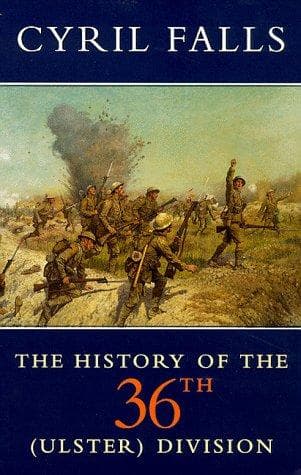
The History of the 36th (Ulster) DivisionFalls, Cyril
History
The History of the 36th (Ulster) Division
Falls, Cyril
Great Britain. Army. Division, 36th; World War, 1914-1918 -- Regimental histories -- Great Britain
"We went up the main front Hindenburg Line. This really was a filthy
place. Corpses were touching, laid along the fire-step, all men of
the 61st Division. I expect the _strafe_ of the afternoon previous
accounted for a great many.... On and on we went and then cut to
the left, where we found an officer called Emerson, of the 9th
Inniskillings. Emerson said we couldn't get further as the Hun was
thirty yards away bombing down the trench. Poor fellow, he thought
his whole company was wiped out, and he had been hit on the head by
a bomb. There was a hole in the top of his tin hat.... He was right
about the Huns. Moore said we were still one hundred and fifty yards
from the machine-gun positions. Some stick bombs fell around us,
several on top of the parapet and one or two in front of us in the
trench. We had about six men slowly falling back--they had no bombs.
One was hit while I was there. I took a squint over the top and saw
the Huns throwing many bombs. They had a light machine-gun in case we
attacked over the open. We threw our few bombs, and that stopped them
for a few minutes. When we stopped throwing they came on again. They
can throw their stick bombs further than a Mills can be chucked by a
normal man. We went on retreating quite slowly. We could have stopped
them all right with bombs. Mulholland[47] ran off to get some, and
finally some reinforcements of the 14th Rifles came up and held the
cross trench, the Hindenburg Line. Here we could easily hold the
Boche as we were right across his front. As there was nothing to do
here, we decided to try to get to the machine-gun positions from the
left flank, the right being effectually closed to us. Just as we were
pushing off, Emerson gathered some men together, got out on top, and
chased the Huns back up the trenches. It was uphill."
This heroic young officer, who had led his company in the original
attack that morning and captured four hundred yards of trench, had,
as Captain Walker remarks, been severely wounded in the head. For
three hours he had rallied the remnants of his company to withstand
the German bombers. He had made a previous attack over the open and
captured six prisoners. On this last occasion of which Captain Walker
speaks, having driven back the Germans at least a hundred yards, he
fell, mortally wounded. He was awarded the posthumous honour of the
Victoria Cross.
Public-domain text, read in full here on John Shaqi.
Reviews
Reviews
No reviews yet
Be the first to share your thoughts on this work.
Elsewhere in the archive
Join the Discussion
Join the discussion
Sign in to leave a comment or review.
Sign InorCreate an account